
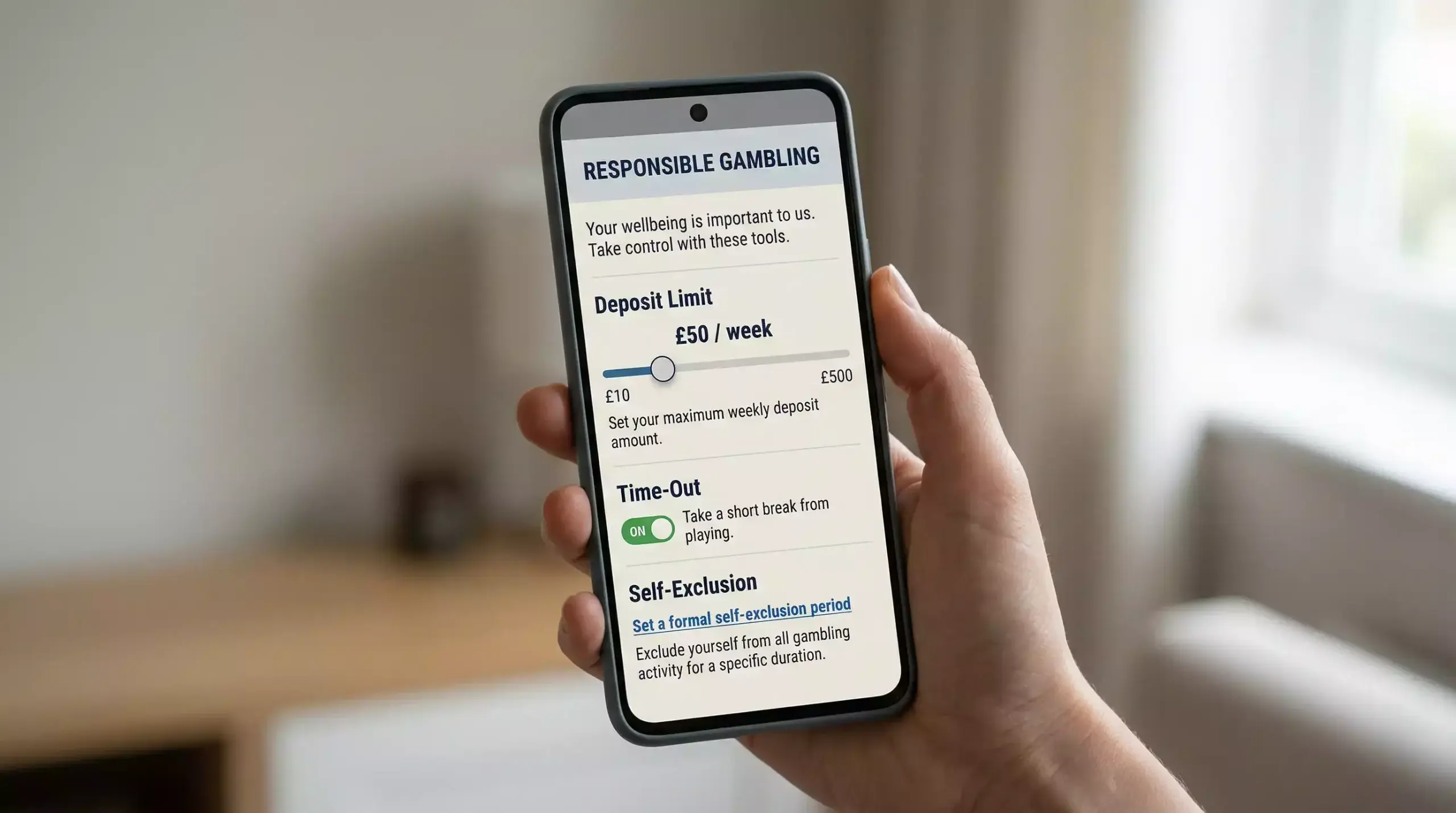

I set a monthly deposit limit on my main betting account in 2021, and it is one of the best decisions I have made. Not because I was in trouble — I was not — but because the limit removes a category of decision from my day. I never have to ask myself “should I deposit more this month?” The answer is always no, because the limit is there. Around 48% of UK adults participated in gambling over the most recent four-week survey period, and the vast majority of them will never experience a serious problem. But the tools exist for everyone, and using them proactively is a sign of discipline, not weakness.
This article covers the practical tools available to UK horse racing punters, how self-exclusion works, and where to find help if betting stops being enjoyable.
Deposit Limits, Time-Outs and Reality Checks
Every UKGC-licensed bookmaker must offer deposit limits — daily, weekly, and monthly caps that you set yourself. Once a limit is in place, you cannot deposit beyond it until the period resets. The mechanics are deliberately asymmetric: reducing a limit takes effect immediately, but increasing one triggers a cooling-off period of 24 to 72 hours depending on the operator. This design prevents impulsive increases during a losing streak while allowing instant tightening when you want to pull back.
Setting a deposit limit is the single most effective responsible gambling tool available. It works mechanically, without relying on willpower in the moment. I recommend setting a monthly limit that matches your discretionary entertainment budget — the amount you would happily spend on a hobby without it affecting your finances. For some people that is 50 pounds; for others it is 500. The number is personal. The principle is universal: define it before you start, not during a losing run.
Time-outs provide a temporary break. You can suspend your account for 24 hours, a week, or a month. During the time-out, you cannot log in, place bets, or deposit. It is a circuit breaker for moments when you feel your betting is becoming reactive rather than analytical. I have used the 24-hour time-out twice — both times after a bad afternoon where I caught myself reaching for my phone to place a bet I had not planned. The break reset my thinking.
Reality checks are periodic notifications that pop up during a session, showing how long you have been active and your net financial position. The 25-34 age group recorded the highest gambling participation rate at 35% in late 2025, and extended sessions — especially on mobile, where the betting app is always in your pocket — are a risk factor for that demographic. Setting a reality check to trigger every 30 or 60 minutes creates a natural pause point.
Loss limits, offered by some operators alongside deposit limits, cap the total amount you can lose in a defined period. This is a sharper tool than a deposit limit because it accounts for winning bets that are reinvested. If your loss limit is 200 pounds per month, your account restricts further betting once net losses hit that threshold, regardless of how much you have deposited.
GamStop Self-Exclusion: How It Works
GamStop is the UK’s national online self-exclusion scheme. When you register, you are excluded from all UKGC-licensed online gambling sites for a period you choose — a minimum of six months, with options for one year or five years. The exclusion is comprehensive: it covers every licensed online bookmaker, casino, bingo, and lottery site operating in the UK.
Registration is free and takes a few minutes. You provide your name, date of birth, email addresses, and any other details linked to your gambling accounts. GamStop shares this data with all participating operators, who are obliged to close your accounts and prevent new registrations. The system is not infallible — determined individuals can sometimes circumvent it by using different personal details — but for most people, it functions as an effective barrier.
During the exclusion period, you cannot reverse the decision. If you chose six months, you must wait the full six months before reactivation becomes possible. Even then, reactivation requires a deliberate request and a further waiting period. The process is designed to prevent impulsive returns during vulnerable moments.
GamStop does not cover on-course betting (bets placed at the racecourse with on-course bookmakers), betting shops on the high street (which have separate self-exclusion schemes), or unlicensed offshore operators. This is a significant limitation — a person excluded from online betting can still walk into a Ladbrokes shop or place a bet at Ascot. The separate high-street self-exclusion scheme, Multi-Operator Self Exclusion (MOSES), covers betting shops but requires separate registration.
Where to Find Help: GamCare, BeGambleAware and More
Nevin Truesdale, the Jockey Club’s former chief executive, argued that the Gambling Commission’s remit is to facilitate safe gambling, not to undermine gambling as an activity. That distinction matters. Safe gambling means that support is available when betting becomes harmful, and knowing where to find that support is part of being an informed punter.
GamCare operates the National Gambling Helpline (freephone, available 24 hours) and provides one-to-one counselling, online chat support, and a network of treatment centres across England, Scotland, and Wales. GamCare’s services are free, confidential, and available to gamblers and their family members.
BeGambleAware is a charity that funds treatment and education around gambling harm. Its website provides self-assessment tools that help you evaluate whether your gambling is within healthy boundaries. BeGambleAware also funds the National Gambling Treatment Service, which offers cognitive behavioural therapy (CBT) and other structured interventions for people experiencing gambling-related harm.
Gordon Moody provides residential treatment for people with severe gambling addiction. The programmes run for 8-14 weeks and offer an immersive, structured environment for recovery. This is the most intensive level of support available in the UK and is funded through GambleAware and the NHS.
If you recognise that your betting is causing stress, financial difficulty, or relationship strain, reaching out to any of these organisations is a practical step. The help is professional, free, and confidential. Nobody is going to judge you for asking — these services exist because gambling harm is a recognised condition with effective treatments.
