
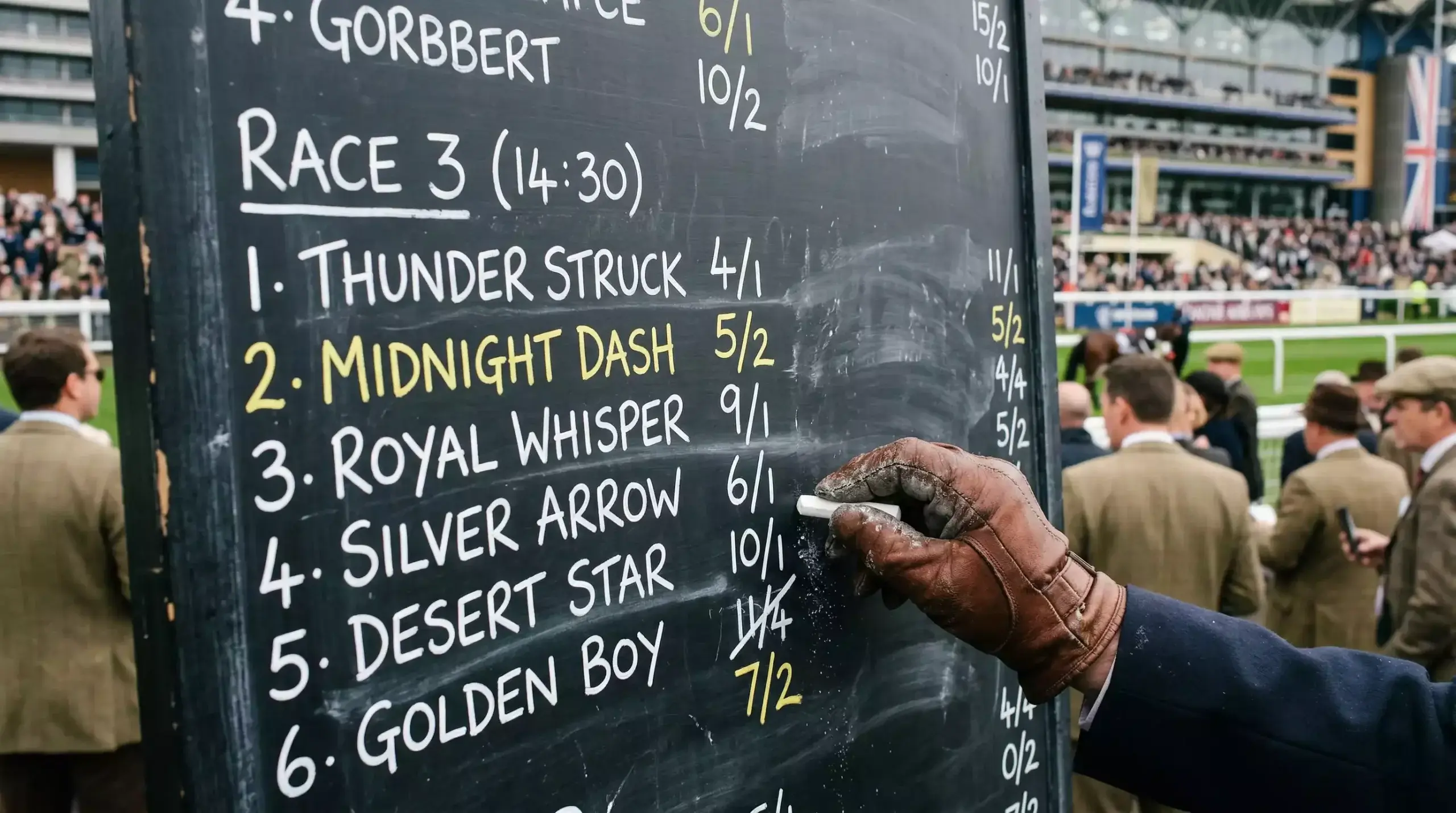

I spent the first year of my betting life treating odds as a ranking system. Lower number equals better horse. Higher number equals worse horse. It took an embarrassing loss on a 1/3 shot — where I staked 30 pounds to win 10 — to make me sit down and actually learn what the numbers meant. That afternoon cost me 30 pounds and saved me thousands, because once you understand how odds work, you stop seeing them as labels and start seeing them as prices. And prices can be wrong.
Horse racing odds are the language of the betting market. They tell you what the bookmaker — or the collective weight of money from other punters — believes about a horse’s chance of winning. Remote betting on horse racing generated 766.7 million pounds in gross gaming yield in the year to March 2025, making it the second-largest betting vertical in Britain after football. All of that money flows through a system built on odds, and understanding that system is the single most important skill a punter can develop.
This guide breaks down the three main odds formats used in UK racing, shows you the maths behind each one, and explains the mechanics that cause prices to move. By the end, you will be able to look at a betting market and see not just who the bookmaker fancies, but where the bookmaker might be offering you a poor deal — or, occasionally, a very good one.
Fractional Odds: The Traditional UK Format
Walk into any betting shop in Britain, watch any racing broadcast, or open any newspaper racing page, and you will see fractional odds. They are the traditional UK format, and despite the rise of decimal pricing on exchanges, they remain the default for most bookmakers and most punters.
A fractional odd like 5/1 — spoken as “five to one” — means that for every one pound you stake, you win five pounds in profit, plus your stake back. A ten-pound bet at 5/1 returns 60 pounds: 50 in profit and your original 10 returned. The left number is what you stand to win; the right number is what you risk. At 7/2, a two-pound stake wins seven pounds profit; a ten-pound stake wins 35 pounds profit.
Where it gets slightly less intuitive is with odds-on prices — fractions where the left number is smaller than the right. A horse at 4/6 is odds-on, meaning the market considers it more likely than not to win. At 4/6, you stake six pounds to win four pounds profit. Odds-on horses win more often than they lose, but the returns per winning bet are smaller than your stake, which is why backing short-priced favourites as a long-term strategy is a mathematical trap unless the horse wins at a rate high enough to offset the slim margins.
Some fractional odds look unfamiliar because they use non-standard denominators. Prices like 11/8, 100/30, or 11/10 appear regularly in horse racing markets and are less common in other sports. They exist because horse racing odds are often set to fine margins, and the traditional on-course bookmaker needed granularity that whole-number fractions could not provide. If the arithmetic feels awkward, multiply both sides to find your return: at 11/8, an eight-pound stake wins 11 pounds profit. At 100/30, a 30-pound stake wins 100 profit. Scaling up from there is straightforward.
One mistake I see constantly is confusing 5/1 with 1/5. They are opposites. At 5/1, you stand to win five times your stake. At 1/5, you need to stake five pounds to win one pound profit. Reading the fraction the wrong way round is an expensive error, and it catches more people than you would expect.
Decimal Odds and Why Exchanges Prefer Them
Decimal odds are the default on betting exchanges and are increasingly available as an option on traditional bookmaker sites. I switched to using them for all my calculations about five years ago, and I have never looked back. They are cleaner, faster, and harder to misread.
A decimal odd represents the total return for every one pound staked, including the stake itself. A horse at 6.00 returns six pounds for every pound wagered — five in profit and one stake returned. That is identical to 5/1 in fractional terms. A horse at 1.67 returns 1.67 pounds per pound staked, equivalent to roughly 4/6 fractional. The formula to convert fractional to decimal is simple: divide the left number by the right number, then add 1. So 7/2 becomes (7 divided by 2) + 1 = 4.50.
Exchanges prefer decimal odds because they allow finer pricing increments. On a traditional bookmaker, the jump between 5/1 and 11/2 is a noticeable gap. In decimal terms, that same range runs from 6.00 to 6.50, and an exchange can offer prices at every increment in between — 6.10, 6.20, 6.30, and so on. This granularity matters when you are trying to find precise value, and it is one reason why exchange prices are often slightly better than bookmaker prices on popular markets.
The key advantage for calculation is that total return is always stake multiplied by the decimal odd. No separate steps for profit and stake. A 15-pound bet at 4.20 returns 63 pounds. A 15-pound bet at 1.85 returns 27.75. The simplicity eliminates the mental gymnastics that fractional odds sometimes require, especially at awkward prices like 100/30.
Converting Odds to Implied Probability
This is where odds stop being numbers on a screen and start being something you can argue with. Every set of odds implies a probability — the market’s estimate of how likely a horse is to win. And if you believe the true probability is different from the implied probability, you have found what punters call “value.”
The conversion from decimal odds to implied probability is one division: 1 divided by the decimal odd, multiplied by 100 to get a percentage. A horse at 4.00 has an implied probability of 25%. A horse at 2.00 implies 50%. A horse at 10.00 implies 10%. In fractional terms, the formula is: right number divided by (left number plus right number), multiplied by 100. So 3/1 implies 1 divided by (3+1) = 25%.
Here is where it gets useful. Suppose you have studied the form, the going, the draw, the trainer’s record at the course, and you believe a horse has a 30% chance of winning. The bookmaker is offering 5/1, which implies a 16.7% probability. Your estimate is nearly double the market’s estimate. That gap — 30% versus 16.7% — is value. If your assessment is accurate, betting at those odds will be profitable over a large number of similar bets.
The difficult part, of course, is being accurate. Estimating true probability is not something you can do with a formula alone. It requires knowledge of the sport, the conditions, and the specific context of the race. But the framework matters, because without it, you have no basis for deciding whether a price is good or bad. You are just guessing. I will cover the practical side of probability estimation in more detail in the betting strategy guide, but the maths starts here: every bet you place is a statement about probability, whether you realise it or not.
The Overround: How Bookmakers Build Their Margin
If you add up the implied probabilities of every horse in a race, the total will not be 100%. It will be more — typically somewhere between 110% and 130% for a standard bookmaker market. That excess is the overround, and it is how the bookmaker makes money.
Think of it this way. In a perfectly fair book, the implied probabilities of all outcomes sum to exactly 100%. If a bookmaker offered such a book, they would make zero profit on average — every pound paid out by losing bettors would be returned to winning bettors. The overround is the margin the bookmaker adds on top of the true probabilities to guarantee a profit regardless of the outcome. A book with a 120% total means the bookmaker has, in effect, sold 120 pence worth of probability for every 100 pence of actual outcomes.
The size of the overround varies. Betting exchanges, where punters bet against each other rather than against the house, typically have much lower margins — often around 102% to 105%, with the exchange taking a commission on winning bets instead. Traditional bookmakers run higher overrounds, and the margin tends to be bigger in larger fields. A five-runner race might have a 110% book; a 20-runner handicap might push past 130%.
This matters because the overround is a direct tax on your expected return. Betting turnover on British racing fell 9% in Q1 2025 versus the same period the previous year, and average turnover per race at Core-level fixtures dropped 14.4%. When the market contracts, bookmakers do not shrink their margins to attract business — they protect them. Understanding where the overround sits in a particular market tells you how much of a headwind you are betting into, and it is one reason why shopping between bookmakers for the best price is not optional: it is the cheapest edge available.
To calculate the overround yourself, convert each horse’s odds to implied probability, sum the lot, and subtract 100. The remainder is the percentage margin. A market totalling 118% has an 18% overround. If you are serious about this, run the calculation on a few races and see how it varies by race type, field size, and bookmaker. The differences are revealing.
How the Starting Price Is Formed
The starting price is one of those concepts that everyone uses and almost nobody understands properly. I certainly did not, until I spent a rainy afternoon at Kempton watching the on-course bookmakers adjust their boards in real time and realised the SP is not some abstract number pulled from a database — it is a snapshot of a live, physical market.
The official SP is determined by the on-course bookmakers at the moment the race starts. An independent SP reporter, employed by the Starting Price Regulatory Commission, surveys the boards of the on-course betting ring and records the prevailing prices at the off. Those prices reflect the weight of money bet on course — not online. This is a crucial distinction: the SP is driven by relatively small amounts of money compared to the online market, which means it can sometimes diverge significantly from the prices offered by the big online bookmakers.
Why does it matter? Because many bets are settled at SP. If you do not take a price when placing your bet, or if you accept “best odds guaranteed” and the SP turns out higher than the price you took, the SP is the number that determines your payout. HBLB Chief Executive Alan Delmonte noted that February and March 2025 produced significantly higher than usual bookmaker gross margins, shaped partly by results at the Cheltenham Festival that favoured the layers. When margins spike, the relationship between early prices and the SP becomes more volatile, and understanding how the SP forms helps you decide whether to lock in a price early or let it ride.
The SP also serves as a benchmark. When I review my betting records at the end of a month, I compare the prices I took against the SP that was returned. If I am consistently beating SP — taking 7/1 on horses that go off at 5/1 — it tells me I am getting value from the market. If the reverse is true, I am leaving money on the table and need to be more selective about when I strike.
Ante-Post Prices: Risk, Reward and No Refund
Ante-post betting is the long game. You are placing a bet days, weeks, or months before a race, at odds that reflect the uncertainty of the intervening period. The prices are longer because the risk is higher, and the risk is higher because of one non-negotiable rule: if your horse does not run, you lose your stake. No refund, no void, no safety net.
The appeal is obvious. Backing a Cheltenham contender in November at 16/1 feels brilliant when it goes off at 5/1 on the day. The gap between the ante-post price and the day-of-race price represents the premium you are paid for accepting the risk of withdrawal, injury, or a change of plan by the trainer. That premium can be enormous — I have seen horses halve in price between the start of the season and race day.
But the risk is real. Horses get injured. Trainers decide a different race is a better fit. The ground turns against them. And when any of those things happen, your money is gone. I restrict ante-post bets to two scenarios: horses whose participation in a specific target race is highly likely based on public statements from the trainer, and markets where the early price is so far above my estimated fair value that the non-runner risk is priced in and then some. If I cannot justify the bet on those terms, I wait for closer to the day and accept the shorter price.
One wrinkle worth noting: some bookmakers offer “non-runner, money back” on selected ante-post markets, usually the major festivals. This removes the non-runner risk but at a cost — the odds will be shorter than the standard ante-post price, because the bookmaker has priced the safety net into the market. Whether the trade-off is worth it depends on how confident you are that the horse will actually line up.
What Makes Odds Shorten or Drift
Odds are not static. They move constantly in the hours and minutes before a race, and understanding why they move is almost as important as understanding what they mean.
The most common driver of price movement is money. When a significant volume of bets lands on a particular horse, the bookmaker shortens the odds to limit their liability. The horse is said to be “steaming” or “shortening.” Conversely, if a horse attracts little interest, its price drifts — lengthens — as the bookmaker extends the odds to attract bets. Watching these movements in real time gives you a window into what the market collectively thinks, and sometimes that collective view is better informed than any individual analysis.
But not all movements are driven by informed money. A horse might shorten because a tipster with a large following has recommended it, flooding the market with bets from punters who have done no independent research. A horse might drift because it looked poor in the parade ring, prompting on-course punters to step away. Information asymmetry is the norm, not the exception. The best-informed money — from connections, from professional punters who have watched the horse work on the gallops — tends to arrive late in the market cycle, often in the final 10 to 15 minutes before the off.
The scale of money involved is substantial. At the 2026 Cheltenham Festival alone, one major operator paid out over 50 million pounds in Best Odds Guaranteed top-ups, which gives you a sense of how much volume flows through these markets during peak events. On an ordinary Tuesday at Catterick, the dynamics are the same but the sums are smaller, and the market is thinner — meaning individual bets can move the price more easily.
How BOG Interacts With the Starting Price
Best Odds Guaranteed bridges the gap between the price you take and the starting price, and it is one of the few features in betting that is genuinely in the punter’s favour — with caveats.
Here is how it works. You back a horse at 8/1 in the morning. By the time the race starts, the SP has drifted to 10/1. Under BOG, your bet is settled at 10/1 rather than 8/1, because the bookmaker guarantees you the better of the two prices. If the SP is shorter than the price you took — say the horse firms to 5/1 — you keep your original 8/1. You cannot lose from the arrangement.
The interaction with SP is where this gets interesting. BOG effectively insures you against taking a price too early. Without it, there is a genuine dilemma: take the current price and risk the horse drifting to a better one, or wait and risk the horse shortening. BOG removes the downside of early action, which changes the optimal strategy. With BOG active, there is no cost to taking a price as soon as you see value. You lock in a floor and retain the upside if the SP is higher.
The caveats are important, though. BOG is not universally available. Most bookmakers apply it to UK and Irish racing only, and some restrict it to bets placed after a certain time — often the morning of the race. There are usually stake limits, meaning that if you place a very large bet, only a portion might qualify for the BOG uplift. And during major festival meetings, when the volume of BOG payouts runs into the tens of millions, some operators tighten the conditions further. Always check the specific terms before assuming BOG applies to your bet.
I treat BOG as a structural advantage. Over a season of betting, the cumulative effect of dozens of small uplifts — a point here, half a point there — adds up to a meaningful improvement in overall returns. It is free money, and ignoring it by failing to bet with BOG-offering bookmakers is leaving value on the table.
Reading the Market: Signals in Price Changes
Market signals are noise until you learn to filter them, and then they become one of the most useful tools available to you. The trick is knowing which movements carry information and which are just churn.
A horse that shortens steadily from 8/1 to 5/1 over the course of an hour is telling you something. Sustained, consistent support across multiple bookmakers suggests genuine confidence from people who are putting serious money behind their opinion. A horse that lurches from 10/1 to 6/1 in the space of two minutes and then bounces back to 9/1 is probably the target of a single large bet that the market has absorbed and corrected. The first pattern is informative; the second is noise.
Drifters — horses whose odds lengthen significantly before the off — deserve attention too. A drift does not automatically mean the horse has no chance, but it does mean the market is not supporting it. Remote betting generates 2.6 billion pounds in total GGY across all sports, with football and horse racing accounting for the lion’s share. The weight of money across those markets is a powerful aggregator of opinion. When that aggregate shifts against a horse, there is usually a reason, even if the reason is not immediately obvious from the form book.
One specific signal I watch for is the late shortener — a horse whose price contracts sharply in the final five minutes before the off. Late money tends to be informed money, because the people waiting until the last moment are often those with inside knowledge about the horse’s wellbeing, the ground conditions on the day, or the jockey’s riding plan. I do not blindly follow late movements, but I factor them into my assessment. If I was already leaning towards a horse and it shortens late, that confirms the lean. If I had ruled it out and it shortens late, I re-examine my reasoning.
Questions About Horse Racing Odds
Odds are not decoration. They are the market’s best guess at reality, expressed as a price. The gap between what the market thinks and what you think is where every profitable bet lives. Learning to read odds fluently — across formats, through the overround, and in the context of market movement — is the foundation that every other aspect of horse racing betting rests on.
