
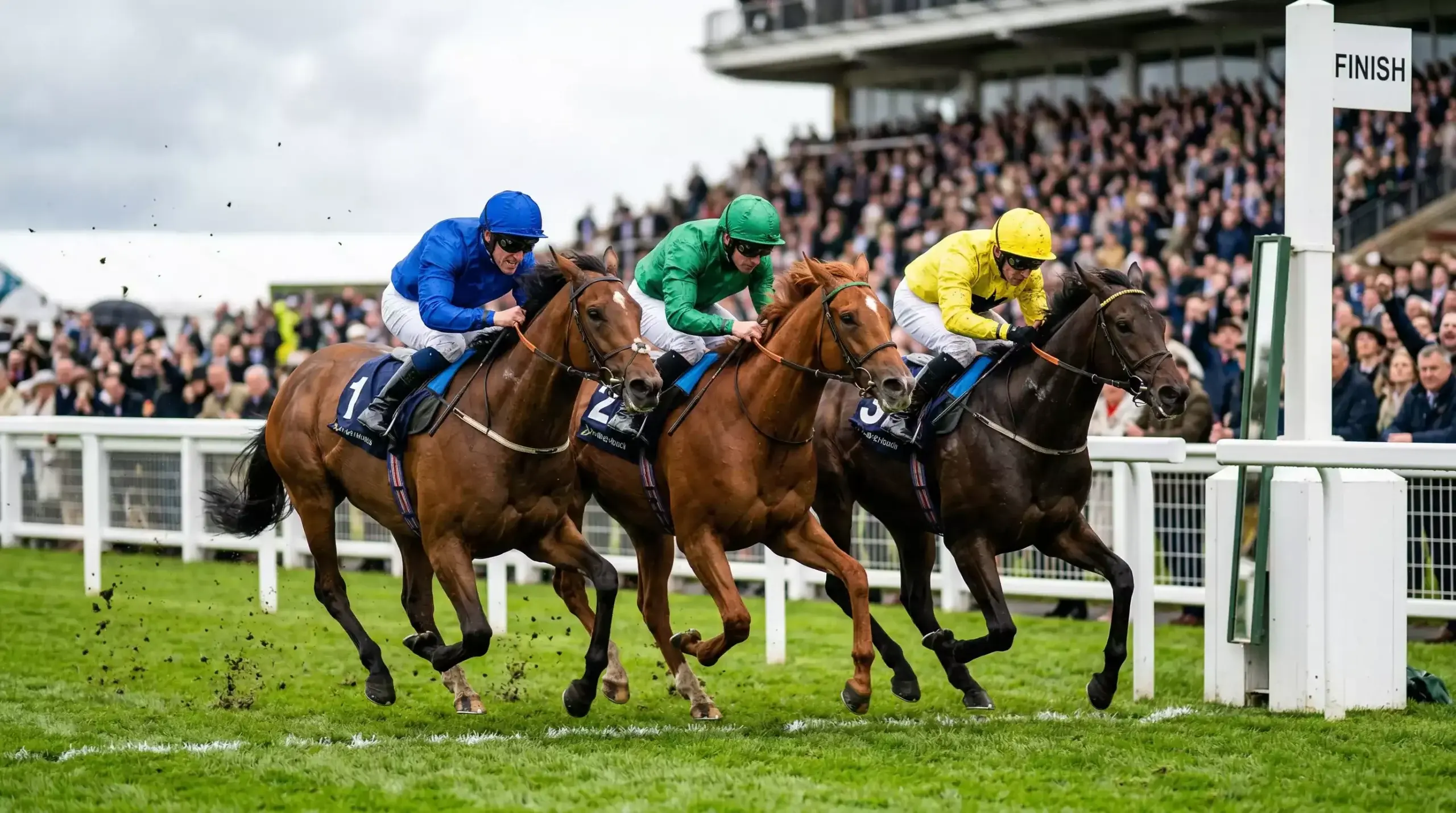

The bet that changed how I thought about horse racing was not a winner. It was a third-place finish in a 16-runner handicap at Newbury, on a 14/1 shot I had backed each-way for a fiver. The horse never looked like winning, but it ran on gamely into a place, and my return was just over 22 pounds on a total outlay of ten. I remember thinking: that is not bad for a horse that lost.
Each-way betting is the most distinctively British form of horse racing wager. It does not exist in most other countries’ betting markets, and it is routinely misunderstood by beginners who assume it is a single bet rather than two. Over 80% of bets at the 2024 Cheltenham Festival were placed through mobile devices, and each-way selections accounted for a growing share of that volume — up 25% on the previous year. The format resonates with punters because it offers a safety net: you do not need your horse to win for the bet to pay out.
But the safety net has a cost, and understanding that cost is the difference between using each-way intelligently and using it as a crutch. This guide covers the structure, the maths, the place terms, and the specific scenarios where each-way genuinely outperforms a straight win bet — and the scenarios where it does not.
How an Each-Way Bet Is Structured
An each-way bet is two bets in one. The first is a win bet — your horse must finish first for it to pay out. The second is a place bet — your horse must finish in one of the designated place positions, which vary by field size and race type. Both bets carry the same stake, which means an each-way bet costs twice the stated unit stake.
This is the point where most confusion begins. If you place a five-pound each-way bet, you are spending ten pounds total: five on the win part and five on the place part. The win part pays at the full advertised odds if the horse wins. The place part pays at a fraction of those odds — typically one quarter or one fifth, depending on the terms — if the horse finishes in a qualifying place position.
Suppose you back a horse at 10/1 each-way for five pounds. Your total outlay is ten pounds. If the horse wins, you collect on both parts: the win bet returns 55 pounds (five pounds at 10/1 plus your stake), and the place bet returns 17.50 pounds (five pounds at 10/4, which is the place fraction of one quarter of 10/1, plus your stake). Total return: 72.50 pounds. If the horse finishes second or third but does not win, you lose the win part (minus five pounds) and collect only the place part: 17.50 pounds. Your net result is a profit of 7.50 pounds on a ten-pound outlay.
If the horse finishes outside the place terms, you lose both parts — the full ten pounds. This is worth emphasising because some punters treat each-way as a low-risk bet. It is lower risk than a straight win bet, yes, but it is not a free ride. You are paying double the unit stake for the privilege of a partial return on a placed finish.
The place fraction is set by the bookmaker and varies by race. The two standard fractions in UK racing are one quarter of the odds (the most common) and one fifth of the odds (used in larger-field handicaps). The fraction directly affects the value of the place part, and in some circumstances it makes each-way a poor bet even when the horse has a strong chance of placing.
Place Terms by Field Size and Race Type
Place terms are not universal. They change based on the number of runners declared for the race and, in some cases, the type of race. Getting this wrong is one of the most common each-way errors, so here are the standard terms used by UK bookmakers.
In races with two to four runners, most bookmakers do not offer each-way betting at all. There are simply too few horses for a place market to function. In races with five to seven runners, the standard terms are one quarter of the odds for the first two places. In races with eight or more runners, the terms extend to one quarter of the odds for the first three places. In handicap races with 12 or more runners, the terms shift to one fifth of the odds for the first three places. And in handicap races with 16 or more runners, the standard terms become one quarter of the odds for the first four places — though many bookmakers offer one fifth of the odds for four places in this bracket instead.
The distinction between one quarter and one fifth matters more than it might seem. On a horse at 12/1, the place part at one quarter odds pays 3/1. At one fifth odds, it pays 12/5, or 2.4/1. On a five-pound place stake, that difference is three pounds in return — not trivial over a season of betting. In large-field handicaps, where the place terms shift to one fifth, the reduction in place value partly offsets the benefit of having four paying positions instead of three.
Where these terms are set in stone for standard racing, bookmakers frequently run “extra place” promotions, particularly for televised races and festival meetings. An extra-place offer might extend the terms from three places to four, or from four places to five, without changing the fraction. These promotions are straightforwardly good value, and I always check for them before placing an each-way bet on a major race.
Extra Places in Handicaps and Festival Races
Festival races and big handicaps are where each-way betting comes into its own, because the combination of large fields, long prices, and enhanced terms creates opportunities that do not exist in smaller races. Racecourse attendance hit 5.031 million in 2025 — the first time it topped five million since 2019 — and the major festivals account for a disproportionate share of both footfall and betting volume.
The Grand National is the extreme example. With 40 runners, the standard each-way terms extend to four places at one quarter odds, and many bookmakers offer five or even six places as a promotion. On a horse at 33/1, a five-pound each-way bet that places returns 46.25 pounds at one quarter odds for five places — a net profit of 36.25 on a ten-pound outlay, from a horse that did not win. The Grand National generates up to 350 million pounds in annual betting turnover, and a significant chunk of that comes from casual punters backing long shots each-way on the biggest race of the year.
Cheltenham works similarly. The big handicaps — the Coral Cup, the County Hurdle, the Grand Annual — typically have fields of 20 or more, and the each-way terms are generous. The key is to check each bookmaker’s specific terms for the race, because they are not always identical. One bookmaker might pay four places at one quarter odds; another might pay five places at one fifth. On the same horse at the same price, those two sets of terms produce different expected returns, and comparing them before you commit takes less than a minute.
Calculating Each-Way Returns Step by Step
I am going to walk through the arithmetic slowly, because getting this right eliminates guesswork and gives you a precise understanding of what you stand to gain or lose.
Start with a concrete example. You back a horse at 8/1 each-way for four pounds. Your total stake is eight pounds (four on the win, four on the place). The race has ten runners, so the terms are one quarter of the odds, first three places.
If the horse wins: the win part returns 4 x 8 + 4 = 36 pounds. The place part pays at 8/4 = 2/1, returning 4 x 2 + 4 = 12 pounds. Total return: 48 pounds. Net profit: 40 pounds.
If the horse places second or third: the win part loses (minus four pounds). The place part returns 12 pounds. Net profit: 4 pounds (12 minus the 8 total stake).
If the horse finishes fourth or worse: both parts lose. Net result: minus eight pounds.
Now take the same scenario but at different odds. At 3/1, the place part at one quarter odds is 3/4. A four-pound place stake at 3/4 returns 4 x 0.75 + 4 = 7 pounds. Your total outlay was eight pounds, so a placed finish at 3/1 actually produces a net loss of one pound. This is the critical insight that many each-way bettors miss: at short prices, the place part does not cover the loss of the win part. Each-way only generates a meaningful place profit when the odds are long enough for the fractional place return to exceed your total stake.
As a rough guide, each-way starts to offer genuine place value at odds of around 4/1 or higher under standard one-quarter terms. Below that, the place return is too slim to justify doubling your stake. At one-fifth terms, the threshold is even higher — roughly 5/1 or above before the place part becomes worthwhile on its own.
For decimal odds users, the place calculation is identical in principle. Divide the decimal odd minus 1 by the place fraction denominator, then add 1. A horse at 9.00 decimal (8/1) with one-quarter terms has a place decimal of (9.00 – 1) / 4 + 1 = 3.00. Multiply your place stake by 3.00 for the total place return.
Dead Heats and Rule 4 in Each-Way Bets
Dead heats complicate things, but the principle is consistent. If two horses dead-heat for a place position, your place stake is settled at half the place odds. Using the 8/1 example with one-quarter terms: the place odds are 2/1, so a dead heat settles at 1/1. A four-pound place stake returns eight pounds — four profit plus four stake. If three horses dead-heat for two place positions, the calculation adjusts further: your place stake is multiplied by two thirds before being settled at the full place odds.
Rule 4 deductions in each-way bets apply to both parts independently. If a non-runner triggers a 15p-in-the-pound deduction, your win return is reduced by 15%, and your place return is also reduced by 15%. The deduction does not apply to your stake — only to the profit portion. In a scenario where the Rule 4 deduction wipes out most of the place profit on a short-priced each-way bet, the net effect can turn a small positive into a small negative. Always factor non-runners into your mental model when betting each-way in races where late withdrawals are common, such as ground-sensitive flat races after overnight rain.
When Each-Way Beats a Win-Only Stake
The question I get asked more than any other is: “When should I bet each-way instead of win only?” The answer depends on three variables: the odds, the field size, and your assessment of the horse’s chance of placing versus winning.
Each-way is stronger than win-only when the horse has a significantly higher probability of placing than winning. This sounds obvious, but the margin matters. A horse at 10/1 in a 16-runner handicap might have a 9% chance of winning and a 35% chance of finishing in the first four. The place probability is nearly four times the win probability, which makes the place part of the bet extremely attractive relative to the win part. The expected return on the place stake alone can be positive, meaning the each-way bet has value even if the win part is marginal. Horse racing participation peaks at 7% of British adults during the spring festival months and drops to 4% in the autumn — and the spring period, with its big-field handicaps at Cheltenham, Aintree, and Royal Ascot, is precisely when each-way betting generates the most value.
Millions of British adults bet on horse racing each year, and a large proportion of those bets are casual each-way wagers on big-field races. The format is popular because it feels forgiving, and in the right conditions, it genuinely is. But there is a flip side. On a horse at 2/1 in a five-runner race, each-way is almost always wrong. The odds are too short for the place fraction to generate meaningful returns, the field is too small for the place probability to diverge far from the win probability, and you are doubling your stake for negligible insurance.
My rule of thumb: if the odds are 5/1 or longer and the field has eight or more runners, each-way deserves consideration. Below those thresholds, win-only is usually the sharper bet. The exception is when you have strong evidence that a horse will place but is unlikely to win — perhaps it lacks the finishing speed to get past two or three superior rivals but is clearly better than the rest of the field. In that case, each-way works even at moderate prices, because the place probability is high enough to carry the bet.
Each-Way Accumulators and Multiples
Each-way accumulators are a niche within a niche, and they can produce extraordinary returns — or, more commonly, nothing at all. The structure is the same as a standard accumulator, but applied twice: one accumulator on the win parts and one on the place parts.
In a four-fold each-way accumulator, you are running eight bets in two parallel chains. The win chain requires all four horses to win. The place chain requires all four horses to place. If three win and one places, the win chain fails but the place chain pays. The place chain return is calculated by multiplying the place odds together across all four legs, and even at fractional place odds, a four-fold place accumulator can return a surprisingly large multiple of your stake.
The risk is compounded probability. In a standard win four-fold, you need four outcomes to land. In an each-way four-fold, the place chain gives you a partial safety net, but you still need all four horses to finish in the places — and in a sport where 30% of favourites win and finishing positions are volatile, the probability of all four placing is lower than most people intuitively estimate.
I use each-way accumulators sparingly and only on days with multiple big-field handicaps where the each-way terms are generous. A Cheltenham Saturday with four handicaps of 16 or more runners is the ideal scenario. A midweek card with four small-field conditions races is not. The format rewards volume and long prices; it punishes short odds and small fields.
Each-Way Angles: Finding Value in the Place Market
The smartest each-way bettors I know do not just look for horses that will place. They look for horses whose place probability is mispriced by the market — where the implied probability of placing, derived from the each-way odds, is lower than the true probability.
One angle that has produced consistent results for me over the years is targeting course specialists in big-field handicaps. A horse that has placed three or four times at a specific track, on a specific type of ground, in a specific distance bracket, has a demonstrable affinity for those conditions. If the form book does not shout “winner” — because the horse has not actually won recently — the win odds tend to be long, which inflates the place part of the each-way bet. The market prices the horse primarily on its chance of winning, but the each-way bettor is effectively buying the place probability at a discount.
HBLB Chief Executive Alan Delmonte noted that February and March 2025 produced unusually high bookmaker margins, partly shaped by results at the Cheltenham Festival. When margins are wide, the each-way market can become particularly distorted, because the bookmaker’s overround compresses place values across the board. In those conditions, each-way bets on longer-priced horses actually become more attractive, because the place odds are still derived from the win odds, and the win odds on outsiders tend to be less aggressively squeezed than those on favourites.
Another angle: late non-runners in big fields. When a fancied horse is withdrawn close to the off, the remaining runners often shorten in price, but the place terms do not change. A 16-runner handicap that loses two runners is still paying four places, but the field is now 14 and the competition for those places has thinned. If you can identify a horse with strong place credentials in a race where late withdrawals have improved its relative chances, the each-way value improves without the odds necessarily reflecting it.
Each-Way Betting Questions Answered
Each-way is not a bet type for every situation. It is a specific tool for specific conditions — long odds, big fields, generous place terms — and using it outside those conditions is a slow way to erode your bankroll. Learn the maths, check the terms, and let the numbers tell you when each-way is the right call.
