
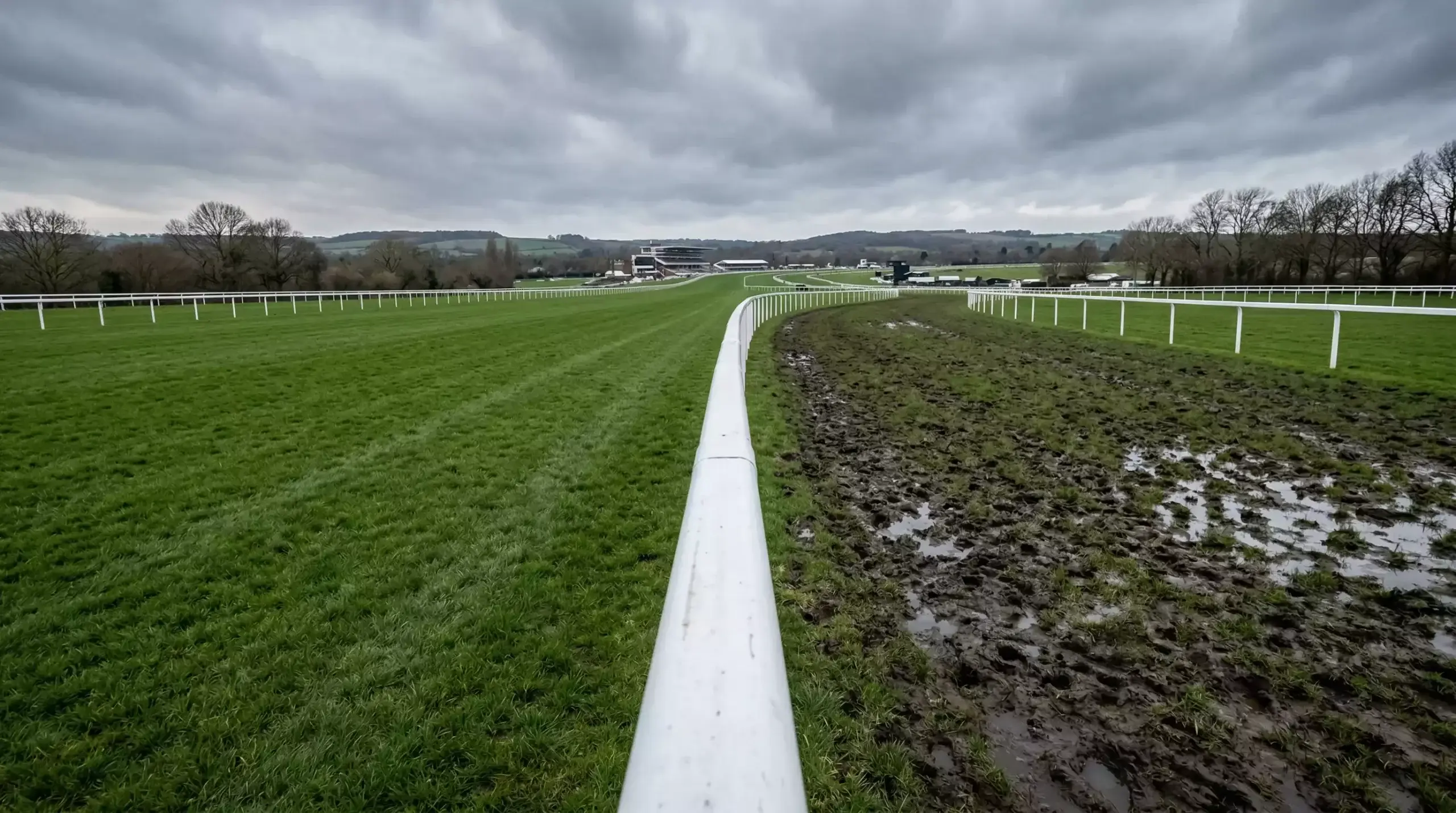

I lost a 50-pound bet at Sandown once because I could not be bothered to check the going. The horse had won twice on good ground and I assumed the going would be similar — it was soft, bordering on heavy, after two days of rain. The horse ran like it was wading through treacle and finished seventh. A two-minute check would have saved me from the bet entirely. In 2025, 87.6% of UK races started within two minutes of their scheduled time, a sharp improvement in timekeeping, but no amount of punctuality helps when you have backed the wrong horse for the conditions underfoot.
Going is one of the most powerful variables in horse racing betting, and it is the one that casual punters most often ignore.
The Going Scale: From Hard to Heavy
The official going scale for turf racing in Britain runs from hard at one extreme to heavy at the other. The full sequence is: hard, firm, good to firm, good, good to soft, soft, heavy. Each descriptor tells you something about how the ground will ride — how much energy a horse needs to cover each stride, how much it will sink, and how the surface will affect race times.
Hard and firm ground is dry, fast, and favours speed horses. Times are quick, and the surface is forgiving in terms of energy expenditure — a horse does not need to pull its hooves out of the ground with every stride. But hard ground carries injury risk: the concussive impact on legs and joints is highest on dry surfaces, and some trainers withdraw horses from firm ground to protect them.
Good ground is the baseline. It is neither fast nor slow, offers a fair test of ability, and suits the widest range of horses. Most form assessments assume good ground as a neutral benchmark.
Good to soft, soft, and heavy ground becomes progressively more demanding. The wetter the surface, the more energy each stride costs. Horses with a long, low action that sweeps through the ground tend to handle soft conditions better than those with a round, high knee action. Heavy ground transforms a race — stamina becomes paramount, speeds drop, and horses that struggle in the mud can finish lengths behind their usual standard.
Between these main descriptors, you will sometimes see hybrid descriptions: “good to firm in places,” “good to soft, soft in places.” These indicate variation across the track and are a useful clue — some parts of the course may ride faster or slower than the headline going.
Where and When to Check the Going
The official going is declared by the clerk of the course, usually on the morning of the meeting and updated throughout the day if conditions change. Rain during racing can shift the going from good to good to soft within an hour. Conversely, a drying wind on a previously wet track can firm things up between the first and last race. The 87.6% of races starting on time in early 2025 reflects operational efficiency, but the going can change between declarations and the actual race — always check the latest update, not just the morning call.
The going stick is an objective measurement tool that supplements the clerk’s subjective assessment. It measures the penetration and shear of the ground, producing a numerical reading. Clerks publish these readings, and they are available on most racing data sites. A going stick reading below 5.0 generally indicates soft or heavy; above 8.0 suggests good to firm or firmer. The number is useful as a cross-check when you suspect the official description might be slightly optimistic or pessimistic.
Weather forecasts are the forward-looking piece. If the official going is good to firm at 8am but three hours of heavy rain is expected before the first race at 2pm, the ground will have changed by race time. Checking the Met Office or a detailed local forecast for the racecourse area is a five-minute investment that can redirect your entire day’s betting.
How Going Preferences Show Up in Form
Every horse has a going preference, even if it has not been explicitly tested across the full range. Some horses only reveal their preference after several runs on different surfaces, and the form book is where that information lives. The question is not just “has this horse won on soft ground?” — it is “how does this horse’s performance change across different going conditions?”
A horse that has won three times on good ground and once on good to soft might seem versatile. But if its good-ground wins were by clear margins and the good-to-soft win was a scrappy short-head, the form tells you it is significantly better on a faster surface. Context matters more than the raw result.
Some horses show a dramatic going preference. I tracked a mare in National Hunt racing who won five times on heavy ground and never finished in the first three on anything faster than soft. Her form figures on heavy read 1-1-2-1-1. Her form on good read 0-0-P-7. The same horse, the same jockey, the same trainer — the going changed everything. Backing her on heavy was almost a formality; backing her on good was throwing money away.
Breeding offers a secondary clue. Certain sires produce offspring with distinct surface preferences. Sons and daughters of stamina-oriented stallions tend to handle softer ground; progeny of speed-focused sires often prefer firmer conditions. This information is most useful for horses with limited form — a first-time-out juvenile whose sire’s offspring have a collective heavy-ground record is worth noting when the rain arrives.
A practical approach: before backing any horse, check its form on today’s going or the nearest equivalent. If it has never raced on the current surface, look at the breeding indicators and the action style. If both suggest the going is unsuitable, move on to the next runner on the card — no bet is better than a bad bet on the wrong ground.
All-Weather Surfaces: A Different Set of Rules
All-weather racing takes place on synthetic surfaces at six UK tracks: Lingfield (polytrack), Wolverhampton (tapeta), Kempton (polytrack), Newcastle (tapeta), Chelmsford (polytrack), and Southwell (fibresand). These surfaces are designed to be consistent regardless of weather, and the going descriptions reflect that: fast, standard to fast, standard, standard to slow, slow.
In practice, all-weather surfaces do vary — they are maintained and watered differently at each venue, and they develop characteristics over time. The horse population in training sat at 15,070 in early 2025, and a meaningful portion of those horses race exclusively or primarily on the all-weather because their form or physical characteristics suit synthetic surfaces better than turf.
The key betting implication is that turf form and all-weather form do not transfer cleanly. A horse with excellent turf form might underperform on polytrack, and vice versa. The most reliable guide is the horse’s own all-weather record: has it run on synthetic surfaces before, and how did it perform? Course-specific form is even more valuable because each surface type rides differently — fibresand at Southwell is notably slower and deeper than the polytrack at Lingfield.
All-weather racing offers year-round betting opportunities, and for punters who develop expertise in these surfaces, the competition is often thinner than on turf. Fewer analysts focus on midweek all-weather racing, which means market pricing can be less efficient — a potentially useful edge for specialists.
