
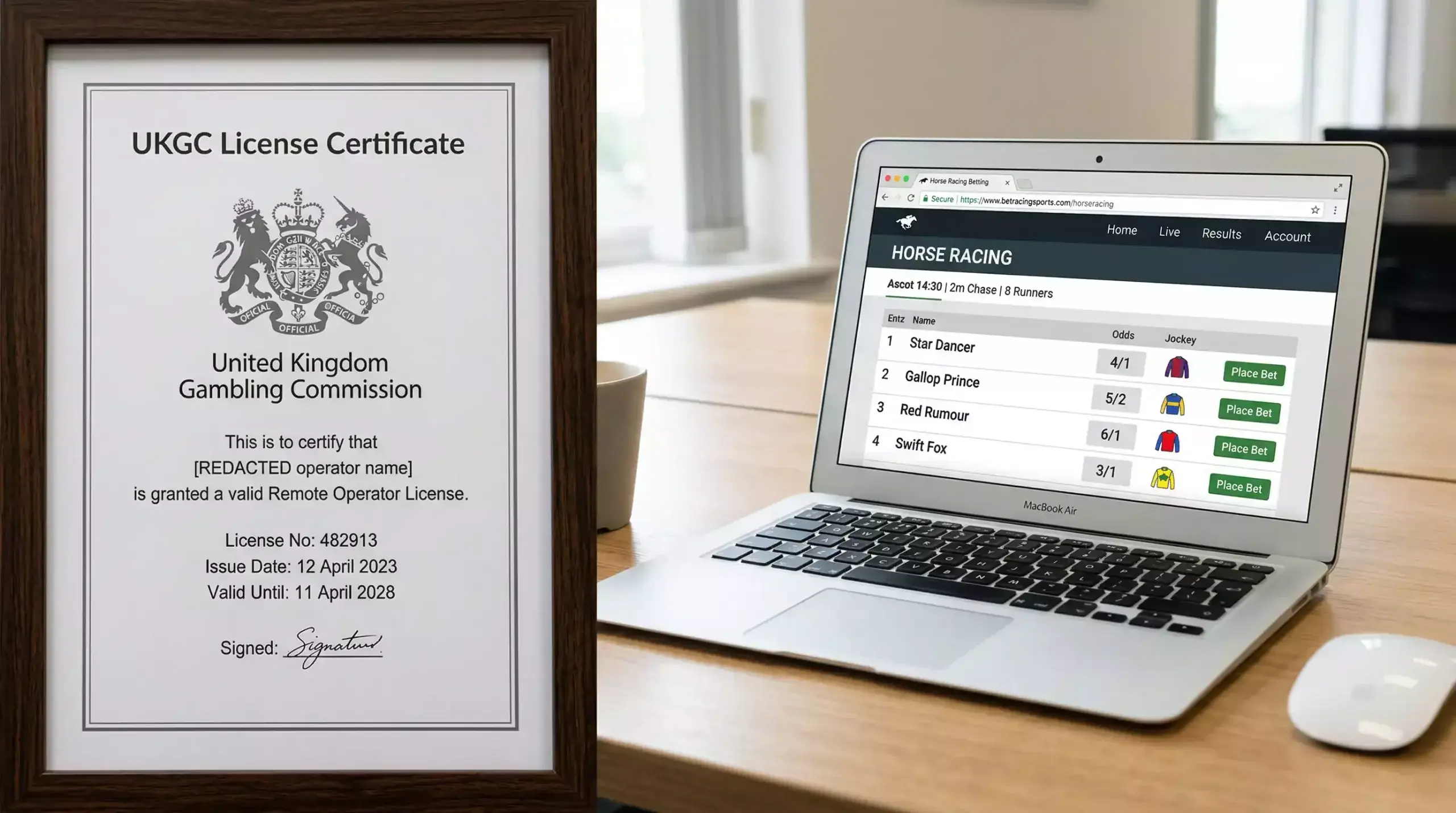

I once had a dispute with a bookmaker over a settled bet — I believed the wrong horse had been credited as the winner due to a dead heat that was not applied correctly. The resolution took three weeks, involved the operator’s complaints team and eventually an independent adjudicator, and I got my money. The entire process was possible because the bookmaker held a UKGC licence, which mandates a dispute resolution procedure. Had I been betting with an unlicensed site, the conversation would have ended with silence. The UK gambling industry generated 16.8 billion pounds in GGY in 2025, and the regulatory framework that underpins that market exists to protect the people who generate it — you, the punter.
This article explains what a UKGC licence actually requires from operators, how to verify one, and what protections you lose when you bet outside the licensed market.
What a UKGC Licence Requires From Operators
A remote operating licence from the UK Gambling Commission is not a rubber stamp. Operators must meet requirements across financial stability, technical standards, customer protection, anti-money-laundering compliance, and social responsibility. The licence conditions run to dozens of pages and cover everything from how customer funds are held to how marketing is conducted.
The financial requirement is foundational. Licensed operators must demonstrate that they hold sufficient funds to cover customer balances and pending payouts. Customer funds must be held in segregated accounts or under equivalent protections — meaning that if the operator goes bust, customer money is ring-fenced and not available to creditors. The level of protection varies (basic, medium, and high segregation), and the operator must publish which level it provides.
Technical standards govern the fairness of the betting product. Random number generators must be independently tested. Odds and bet settlement must follow published rules. The operator must maintain a clear audit trail of every bet, settlement, and financial transaction. The 2025 Budget set Remote Gaming Duty at 40% for online casino but left horse racing at 15% plus the 10% Levy — a structure that only applies to UKGC-licensed activity.
Anti-money-laundering (AML) obligations require operators to verify customer identity, monitor for suspicious activity, and report to the National Crime Agency where appropriate. The Know Your Customer (KYC) process that every new account holder goes through — uploading ID, confirming address, verifying age — is an AML requirement built into the licence conditions.
Social responsibility conditions include the obligation to offer self-exclusion, provide deposit limits, display responsible gambling messaging, and train staff to identify signs of problem gambling. The affordability check framework sits within this broader social responsibility mandate.
How to Verify an Operator’s Licence
The Gambling Commission’s public register is available online and is the definitive source. You can search by operator name, trading name, or website address. The register shows the licence type (remote, non-remote, or both), the licence number, the company’s legal name, and the current status of the licence.
Every licensed operator is required to display its UKGC licence number on its website and within its app — typically in the footer. The number is a clickable link or a verifiable reference that you can cross-check against the public register. If the number does not appear, or if it does not match the register, treat the site with extreme caution.
Some operators hold licences from other jurisdictions (Malta Gaming Authority, Gibraltar Gambling Commissioner) in addition to the UKGC. These secondary licences are relevant to the operator’s international business but do not replace the UKGC licence for serving UK customers. Since 2014, any operator offering gambling to British residents must hold a UKGC licence — there is no exemption based on holding a licence elsewhere.
Safer Gambling Tools Mandated by the UKGC
Nevin Truesdale, former CEO of the Jockey Club, argued that the Gambling Commission risks slipping into an anti-gambling stance rather than facilitating safe betting. Whether or not you share that view, the safer gambling tools mandated by the UKGC provide tangible protections that no unlicensed operator is obliged to offer.
Deposit limits — every licensed operator must allow you to set daily, weekly, and monthly deposit caps. Once set, a limit can only be increased after a cooling-off period (usually 24-72 hours), but it can be decreased immediately. This asymmetry is deliberate: it prevents impulsive increases while allowing instant reductions.
Time-outs and cooling-off periods — you can temporarily suspend your account for a set period (24 hours, 48 hours, one week, one month). During a time-out, you cannot log in, deposit, or bet. Some operators also offer session time reminders that notify you after a specified period of continuous activity.
Reality checks — periodic pop-up notifications that display how long you have been playing and your net position (total deposits minus total withdrawals) during the session. The frequency of these notifications is configurable. The 25-34 age group showed the highest gambling participation rate at 35% in late 2025, and reality checks are designed to interrupt the kind of extended sessions that can lead to overspending.
Self-exclusion via GamStop — a free national scheme that lets you exclude yourself from all UKGC-licensed online gambling sites for a minimum of six months and up to five years. Registration with GamStop is shared across all licensed operators, so a single registration blocks you from every regulated site. Unlicensed operators do not participate in GamStop, which is one reason the scheme’s effectiveness is limited by the existence of the offshore market.
These tools are not perfect, and they do not prevent every instance of gambling harm. But they represent a layer of protection that exists solely because the operator is licensed. When you bet with an unlicensed site, every one of these tools disappears.
What Happens When Something Goes Wrong
Disputes between punters and bookmakers are inevitable. Bets are settled incorrectly, promotions are misapplied, accounts are restricted without clear explanation. Within the licensed market, there is a structured resolution path.
The first step is the operator’s internal complaints procedure, which every UKGC-licensed company must maintain. You submit your complaint, the operator investigates, and you receive a response — typically within eight weeks. If you are not satisfied with the outcome, you can escalate to an Alternative Dispute Resolution (ADR) provider — an independent body approved by the UKGC to adjudicate disputes between punters and operators.
ADR decisions are binding on the operator. If the adjudicator rules in your favour, the bookmaker must comply. This mechanism exists because the licence mandates it, and operators that refuse to comply risk regulatory action. The process is not fast — it can take months — but it provides a genuine avenue of recourse.
In the event of operator insolvency, the level of customer fund protection becomes critical. Operators with high-level fund segregation hold customer money in trust, meaning it is returned to customers even if the company fails. Operators with basic protection do not offer the same guarantee, and customer funds may be at risk. The Gambling Commission publishes each operator’s fund protection level, and checking this before depositing significant sums is prudent.
Outside the licensed market, none of this exists. An unlicensed operator has no obligation to respond to complaints, no regulatory body enforcing compliance, and no fund protection. If the site disappears or refuses to pay, your money goes with it.
