
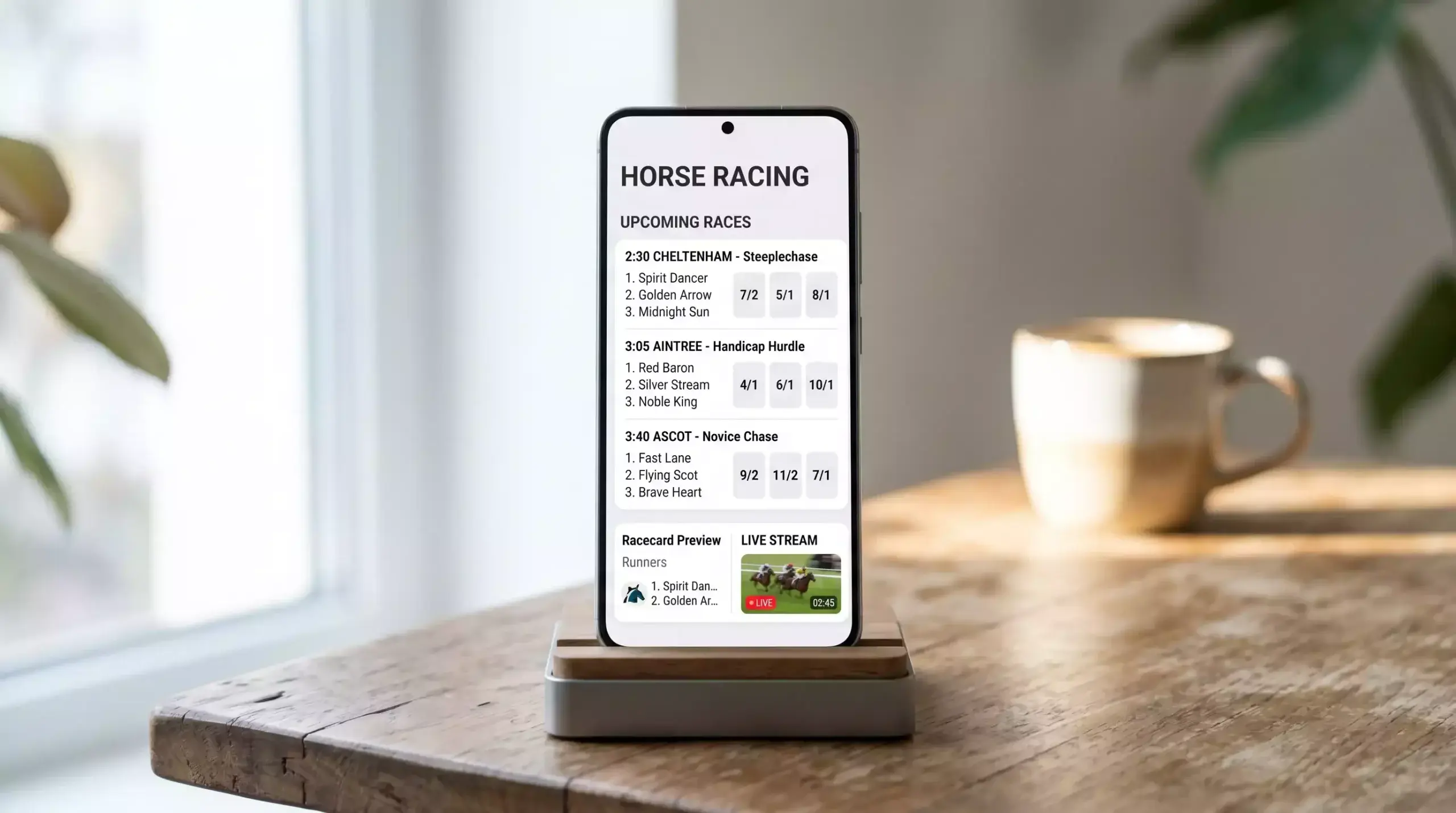

I switched my primary betting app three times in 2024, each time because a specific feature irritated me enough to move. The first app crashed during in-play betting at Cheltenham — precisely the worst moment for a technical failure. The second had brilliant odds but a racecard layout so cluttered that finding the form figures felt like an archaeology project. The third got it right: clean interface, fast bet placement, and live streaming that actually worked on mobile data. More than 80% of bets at Cheltenham 2024 were placed via mobile, which makes the quality of a bookmaker’s app the single biggest factor in your day-to-day betting experience.
This article covers what separates a good horse racing app from a mediocre one and how to evaluate them before committing your money.
What Makes a Good Horse Racing Betting App
A betting app is not just a miniaturised version of a website — it is a tool you use under pressure, often in noisy environments with patchy signal, when a race is about to start. The criteria that matter most are speed, reliability, and the quality of the racing-specific interface.
Speed means two things: how quickly the app loads race markets, and how quickly it processes a bet from selection to confirmation. A lag of three seconds between tapping “place bet” and receiving confirmation can be the difference between getting your price and missing it. The best apps confirm bets in under a second on a reasonable connection. The worst take five or six seconds and occasionally time out, leaving you unsure whether the bet was placed.
Reliability is non-negotiable. An app that crashes on Grand National day, freezes during Cheltenham, or fails to load when you have mobile data rather than Wi-Fi is not fit for purpose. The simplest way to test reliability before committing is to use the app on a busy Saturday afternoon — if it holds up under peak load, it will handle anything.
The racing-specific interface matters more than you might think. A good horse racing app gives you integrated racecards, form summaries, and odds on the same screen without excessive scrolling. You should be able to see the horse’s name, form figures, trainer, jockey, and current odds in a single view. Apps that bury the racecard three taps deep or force you to switch between the card and the betslip are wasting your time.
Key Features: Streaming, Cash Out, Quick Bet
Three features separate a functional betting app from one that enhances your racing experience: live streaming integration, cash-out capability, and quick-bet functionality. The mobile betting revolution that put 80% of Cheltenham wagers onto smartphones has raised the bar for what these features need to deliver.
Live streaming embedded in the app means you can watch the race and manage your bets on the same device. The best implementations show the stream in the top half of the screen with the betslip and market below, so you can place an in-play bet or cash out without pausing the stream. Apps that open the stream in a separate window or require you to exit the stream to access the betslip are behind the curve.
Cash out lets you settle a bet before the race finishes. On mobile, the cash-out button needs to be immediately accessible — one tap to see the offer, one tap to accept. Any additional confirmation steps or loading delays reduce its usefulness, because cash-out values change rapidly during a race. Partial cash-out (taking some of your profit while leaving a portion running) is available on some apps and is a useful risk-management tool.
Quick bet is a one-tap or two-tap bet placement that skips the full betslip. For experienced punters who know what they want — a five-pound each-way at the current price — quick bet removes friction. You set a default stake, tap the odds, confirm, done. Some apps let you configure quick-bet presets for different stake amounts and bet types (win, each-way, forecast).
Push notifications for racing — price changes on selections you have favourited, non-runner alerts, result notifications — are a secondary feature that some punters find essential and others find annoying. The best apps let you customise which notifications you receive rather than imposing a one-size-fits-all alert system.
Comparing Top Apps by Performance
I am not going to name “the best app” because it depends on what you prioritise. What I can do is describe the categories of difference and let you evaluate for yourself. William Hill accounted for 37.83% of PPC advertising clicks in sports betting in early 2026, and their market position reflects sustained investment in digital products — but advertising spend does not directly correlate with app quality.
The operators with the largest market share tend to have the most polished apps simply because they invest the most in development. However, some mid-tier operators punch above their weight on specific features — faster bet processing, cleaner racecard layouts, or better streaming integration. The only reliable way to compare is to install two or three apps, fund each with a small amount, and use them in parallel across a few race meetings.
Pay attention to the racecard depth. Some apps show only the horse name and odds; others display full form, going preference, trainer statistics, and even course-and-distance records. The difference between a shallow racecard and a deep one is significant if you use the app as your primary research tool on race day.
Check how the app handles multiple bets. If you want to place three separate each-way bets across an afternoon, does the app remember your stake preference? Does it take you back to the race list after confirming a bet, or does it dump you on a confirmation page that requires manual navigation to get back? These small workflow details add up over a full day of racing.
Finally, test the app on the worst connection you are likely to have. At a racecourse, mobile signal can be congested. In a rural area, 4G might drop to 3G. If the app degrades gracefully — slower but still functional — that is acceptable. If it crashes or fails to place bets entirely, that is a dealbreaker.
Security, Biometrics and Responsible Gambling Controls
Every horse racing betting app available in the UK must be operated by a UKGC-licensed company, which means baseline security standards are mandated: encrypted data transmission, segregated customer funds, and identity verification at registration. The affordability check threshold of 150 pounds in net monthly deposits also applies to app-based deposits, just as it does to desktop.
Biometric login — Face ID, Touch ID, or fingerprint — is standard on modern betting apps and removes the friction of entering passwords while adding a layer of security. If your app supports biometrics, enable them. A lost phone with an unlocked betting app is a risk no one needs.
Responsible gambling controls should be accessible within two taps from the app’s home screen. Look for deposit limits (daily, weekly, monthly), loss limits, session time reminders, cooling-off periods, and self-exclusion options. The best apps surface these tools proactively — a pop-up after a losing streak, a gentle reminder of time spent in-app — rather than burying them in a settings submenu. If an app makes it harder to set a deposit limit than to place a bet, that tells you something about the operator’s priorities.
