
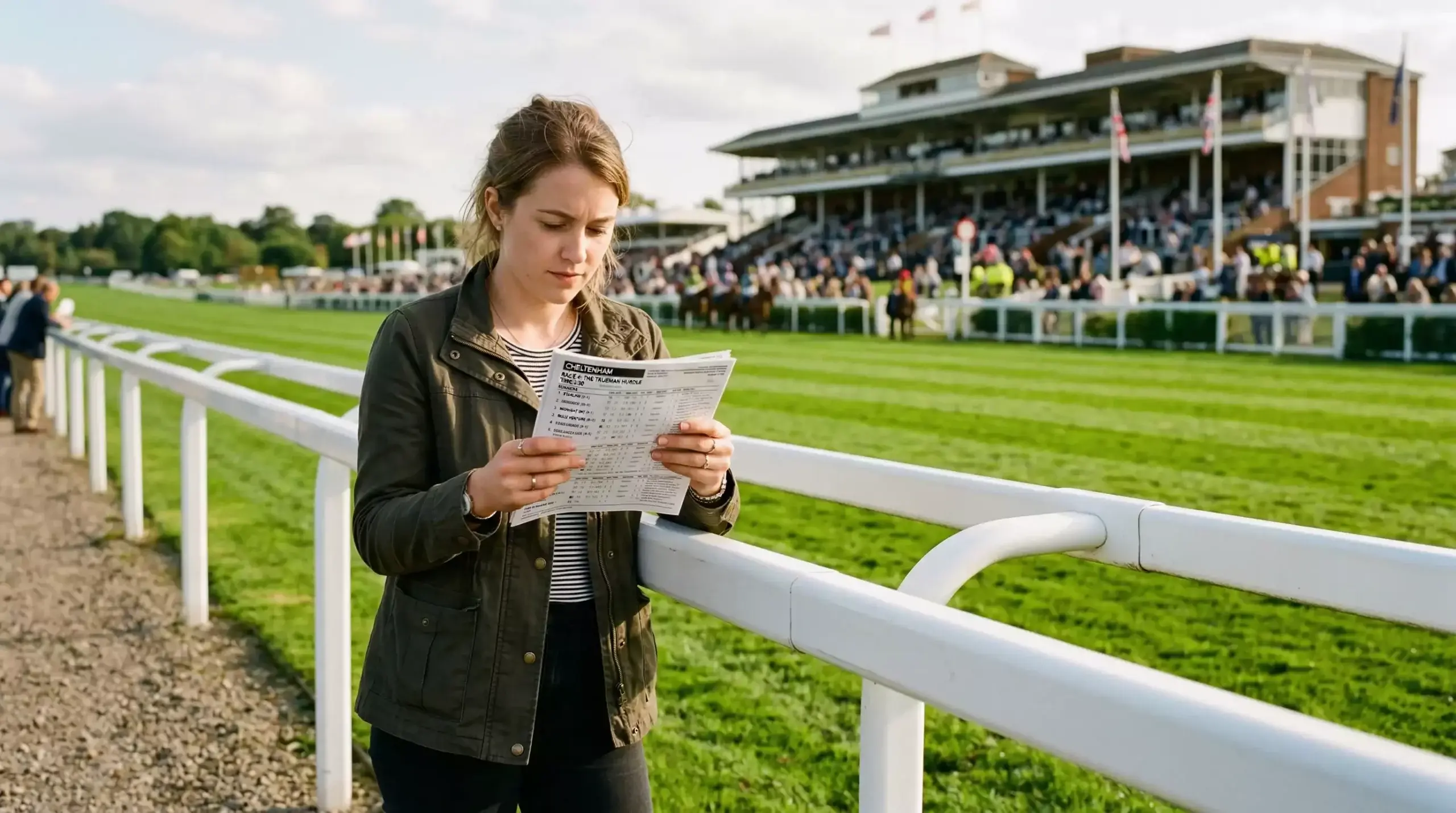

I still remember my first day at Newbury. A mate handed me a racecard, pointed at a horse called something ridiculous — I think it was “Biscuit Thief” — and said, “stick a fiver on that one, it’s got a nice name.” I did. It finished last. That afternoon cost me about forty pounds and taught me absolutely nothing, because nobody had explained what I was actually doing. I just threw darts at a board and called it fun.
The thing is, horse racing betting is not complicated once someone strips away the jargon and the mystique. About 68% of people who walk through racecourse turnstiles in Britain are casual or first-time visitors, and most of them feel the same mild panic when they see columns of numbers, strange abbreviations, and a field of horses they have never heard of. That feeling fades fast once you understand a handful of core ideas. Around 4-7% of UK adults bet on horse racing in any given month — a number that spikes during the spring festival season — so you are far from alone in wanting to learn the basics.
This guide exists because I wish someone had written it for me ten years ago. No waffle, no hard sell, no assumed knowledge. Just the essentials you need before you part with real money.
What Horse Racing Betting Actually Involves
The first race I ever studied properly was a six-runner novice hurdle at Haydock on a rainy Tuesday. Nobody in the pub cared about it. But breaking that race down taught me more than a dozen Grand Nationals watched from a sofa. Horse racing betting, at its core, is about expressing an opinion on the likely outcome of a race and putting money behind that opinion.
You pick a horse, decide how much to risk — your stake — and choose a bet type. The simplest is a win bet: your horse finishes first, you get paid. If it does not, you lose your stake. That is the entire transaction. Everything else in racing betting is a variation on that theme.
The price you are offered — the odds — tells you what the bookmaker thinks about your horse’s chances and, more importantly, what you stand to receive if it wins. Odds of 4/1 mean you receive four pounds for every one pound staked, plus your stake back. Odds of 1/2 mean you receive fifty pence for every pound, because the horse is a strong favourite. Understanding that relationship between risk and reward is the single most valuable thing a beginner can learn.
Bookmakers do not set odds in a vacuum. They use form data, market demand, and competitor pricing. The market is a living thing — odds shorten when money floods in on a horse and drift when nobody wants it. You do not need to master market dynamics on day one, but knowing they exist stops you treating the odds as some kind of absolute truth handed down from above.
There are roughly 1,500 race meetings a year across Britain’s 59 racecourses, which means opportunities to bet are almost constant. The sport splits into two codes — flat racing, which runs primarily from April to October, and National Hunt (jumps), which fills the winter months with hurdles and steeplechases. Both follow the same basic betting principles, so learn one and you have a head start on the other.
Ten Terms You Will Hear Immediately
I once watched a newcomer at Cheltenham ask a bookmaker what “SP” meant, and the on-course bookie just stared like he had been asked to explain gravity. Racing assumes you already know the language, which is annoying if you do not. Here are ten terms that will come up within minutes of your first bet.
Stake — the amount of money you put down. If you bet five pounds, your stake is five pounds. Odds — the price offered on a horse, expressed as a fraction (5/1) or decimal (6.0). It tells you the potential return relative to your stake. SP (Starting Price) — the official odds at the moment the race begins, determined by on-course bookmakers. If you do not take a price earlier, your bet settles at SP.
Each-way — a bet split into two equal parts: one on the horse to win, one on it to finish in the places (usually top two, three, or four depending on the field size). It costs double your stake but gives you a return even if the horse does not win. Accumulator (acca) — a single bet linking multiple selections across different races. All must win for the bet to pay out. The potential returns multiply, but so does the difficulty.
Form — a horse’s recent race results, shown as a string of numbers and letters. A “1” means it won, “2” means second, “0” means it finished outside the top nine, and “F” means it fell. Going — the condition of the ground. It ranges from “firm” (dry and fast) to “heavy” (waterlogged and slow). Some horses perform dramatically differently depending on the going.
Racecard — the printed or digital rundown of every horse in a race, including form, trainer, jockey, weight carried, and draw position. BOG (Best Odds Guaranteed) — a promotion offered by most major bookmakers that pays you the higher of your price or the SP if the starting price is better than the odds you took. Non-runner — a horse that was declared to run but has been withdrawn before the race starts. Your stake is normally refunded on a non-runner unless you placed an ante-post bet.
You do not need to memorise all of these before placing a bet, but recognising them when they appear will stop you feeling lost. For a full A-Z reference, there is a dedicated horse racing betting terminology glossary on this site.
Your First Three Bets: A Suggested Path
When I mentor newcomers — and I have done this at charity racedays a few times — I always suggest the same three-bet progression. Not because it is a magic formula, but because it builds understanding without burning through a bankroll.
Bet one: a simple win bet on a short-priced favourite. Pick any race with a clear market leader — something priced around 6/4 or 2/1. Stick a small stake on it. The point is not profit; it is to follow the mechanics. Watch how the betslip works, notice what happens when the race finishes, see how the settlement appears in your account. About 30% of favourites win in UK racing, so there is a decent chance you will get a return, which keeps the exercise positive.
Bet two: an each-way bet on a mid-priced horse. Find a handicap with twelve or more runners and select something priced between 8/1 and 14/1. This time, pay attention to the place terms — at twelve runners, you typically get paid on the first three places at one-quarter of the odds. If it finishes third, you lose the win part but collect on the place part. Understanding each-way is the single biggest unlock for a beginner because it adds a safety net to your betting without requiring you to find winners every time.
Bet three: a bet informed by one piece of form. Before this bet, look at the racecard. Find a horse whose form figures include a “1” or “2” on similar ground conditions to today. That tiny bit of homework is the difference between guessing and wagering. It does not guarantee a winner, but it starts building the habit of checking evidence before backing a horse.
After those three bets, you will have experienced a win bet, an each-way bet, and the basic process of form analysis. That is more structured learning than most people get in their first year of punting.
Beginner Traps and How to Avoid Them
A few years ago, I kept a spreadsheet of every mistake my mates made when they started betting on racing. After about six months, the same five problems accounted for roughly 80% of their unnecessary losses. Here they are, in order of how much damage they do.
Betting every race. There are sometimes thirty or forty races on a busy Saturday card. Betting on all of them is the fastest way to empty a wallet. The sharpest punters I know bet on fewer than 10% of races they analyse. Be selective. If you do not have an opinion, do not have a bet.
Chasing losses. You lose three bets in a row, so you double the stake on the fourth to get your money back. This is the oldest trap in gambling and it never stops catching people. Set a loss limit before you start and walk away when you hit it. That discipline alone will keep you in the game longer than most.
Ignoring the going. A horse that cruised to victory on firm ground might flounder in the mud. Beginners often ignore ground conditions entirely because the information seems technical. It is not. “Firm” means fast, “heavy” means slow. Check whether your horse has won on today’s going before you bet.
Treating tips as gospel. Newspaper tipsters, social media accounts, your uncle who “knows a trainer” — everyone has an opinion. Tips can be a useful starting point, but they should prompt your own research, not replace it. No tipster in history has maintained a long-term profit without rigorous selection criteria, and the free ones rarely share their methodology.
Skipping the terms and conditions. Free bets, welcome offers, cashback promotions — they all have rules. Minimum odds requirements, wagering conditions, expiry dates. Five minutes reading the small print saves the frustration of discovering your “free” bet does not actually work the way you assumed. British gambling generated over 16 billion pounds in gross gambling yield in 2025, and a significant slice of that came from punters who did not read the fine print.
