
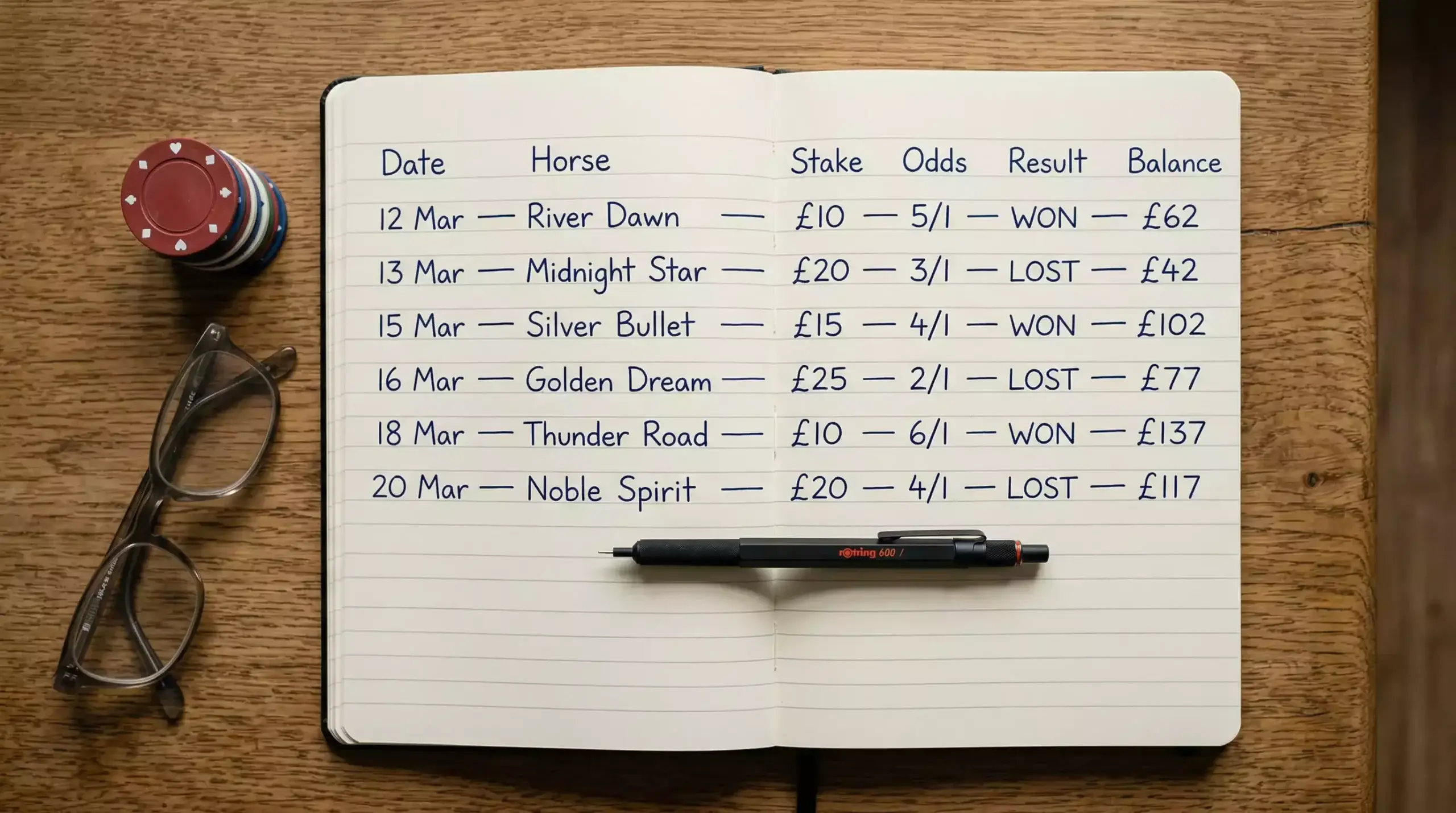

The best tipster I ever followed had a 22% strike rate and averaged level-stakes profit of 8 points per 100 bets. Impressive numbers. I still managed to lose money following his selections in 2020 because I had no staking discipline. I doubled up after winners, tripled up on “certainties,” and went all-in on a 5/1 shot that lost by a nose. My selections were profitable; my bankroll management was catastrophic. About 48% of UK adults gamble in any given month, and I would bet a significant share of those who punt on horses make the same mistake I did — the problem is not what they back, it is how much.
This article covers three staking approaches, the maths behind each, and why the boring discipline of managing money is worth more than the most exciting selection method in the world.
Why Bankroll Management Outweighs Selection Skill
Horse racing participation sits between 4% and 7% of UK adults in any given month, depending on whether it is festival season or the quiet summer flat months. That is a lot of people placing bets, and the vast majority of them focus entirely on picking horses without any structured approach to how much they stake. It is the equivalent of being a brilliant cook who leaves the oven door open — the skill is real, but the execution undermines the result.
Selection skill determines whether your bets have positive expected value. Bankroll management determines whether you survive long enough to realise that value. Even a profitable strategy — say, a 15% return on investment — will produce losing runs of 15 or 20 bets. If your staking plan cannot absorb those runs without depleting your bankroll, the long-term edge never materialises.
I ran a simulation once: 1,000 bets at an average price of 4/1 with a 22% strike rate (a genuinely profitable strategy). With flat 5% stakes, the bankroll survived every run I modelled. With unstructured staking — sometimes 2%, sometimes 10%, occasionally 20% — roughly 30% of simulated bankrolls hit zero before reaching the 500-bet mark. Same strategy, same edge, wildly different outcomes. That simulation changed how I bet permanently.
Level-Stake Betting: Simplicity and Limits
Level-stake betting is the simplest approach: every bet uses the same fixed stake, regardless of the odds, the race, or your confidence level. If your unit is 10 pounds, every bet is 10 pounds. No variation, no negotiation with yourself.
The strength of level staking is its psychological simplicity. There is no decision to make about how much to bet — you just bet your unit. That removes one entire category of emotional interference. After a bad run, you do not increase your stakes to chase losses. After a good run, you do not increase them out of overconfidence. The approach is mechanically neutral.
The weakness is that it ignores information. A bet at 10/1 where you assess the true odds at 6/1 (a strong value bet) gets the same stake as a bet at 3/1 where you assess the true odds at 5/2 (marginal value). The Kelly Criterion — which we will get to — would allocate more to the 10/1 selection and less to the 3/1, reflecting the difference in edge. Level staking treats them identically.
For most recreational punters, level staking is the right choice. It is easy to implement, easy to track, and it prevents the most common staking errors. A level stake of 1-2% of your total bankroll per bet provides enough cushion to withstand long losing runs while still generating meaningful returns when the winners come.
Percentage Staking: Adjusting to Your Balance
Percentage staking sets each bet as a fixed percentage of your current bankroll, not a fixed pound amount. If your bankroll is 500 pounds and your staking percentage is 2%, your first bet is 10 pounds. If the bankroll drops to 400 pounds after a losing run, the next bet is 8 pounds. If it grows to 600, the bet is 12 pounds.
The mathematical elegance here is that you can never lose your entire bankroll. As the balance shrinks, so do the stakes, and it is arithmetically impossible to reach zero through fixed-percentage staking alone. In practice, of course, a bankroll can shrink to a level where the stakes are too small to be meaningful — but the system prevents a total wipeout.
The downside is that recovery from a drawdown is slower than with level staking. After a losing streak that halves your bankroll, your stakes are also halved, so you need proportionally larger gains to climb back. With level staking, the stakes remain constant, which means a good run after a bad run recovers the bankroll faster.
Percentage staking is best suited to punters with a defined edge who are betting for the long term. If you know your strategy is profitable over hundreds of bets, percentage staking maximises the probability that you will still have a bankroll when the edge eventually asserts itself. If you are unsure whether your strategy is profitable, the slow recovery from drawdowns can feel punishing.
Kelly Criterion Applied to Horse Racing
The Kelly Criterion is a formula that calculates the optimal stake based on the size of your edge and the available odds. It was developed by John Kelly at Bell Labs in 1956 and has been adopted by a small but committed community of professional horse racing punters.
The formula is: stake = (bp — q) / b, where b is the decimal odds minus 1, p is your estimated probability of winning, and q is (1 — p). If you estimate a horse has a 25% chance of winning and the odds are 5/1 (decimal 6.0, so b = 5), the Kelly stake is (5 x 0.25 – 0.75) / 5 = 0.50 / 5 = 0.10 — that is, 10% of your bankroll.
In theory, Kelly Criterion maximises long-term bankroll growth by allocating more to high-edge bets and less to marginal ones. In practice, full Kelly staking is extremely volatile. A 10% stake on a single horse racing bet is aggressive by any standard, and a sequence of losing bets at full Kelly can produce drawdowns of 40-50% in a week.
Most professionals who use Kelly in racing apply a fraction — typically quarter-Kelly or half-Kelly. This reduces the volatility while retaining the proportionality between edge and stake. A quarter-Kelly stake on our earlier example would be 2.5% of the bankroll, which is far more palatable and still allocates more capital to stronger bets.
The biggest challenge with Kelly is that it requires an accurate estimate of the true winning probability. If your probability estimate is wrong, the formula outputs a wrong stake. Overestimating your edge leads to overstaking; underestimating it leads to understaking. Given that estimating true probabilities in horse racing is inherently imprecise, the Kelly Criterion is a tool for experienced punters who have calibrated their probability assessments over thousands of bets, not a shortcut for beginners.
Handling Losing Runs: Drawdown and Recovery
Every staking plan in the world will subject you to losing runs. At a 20% strike rate (a profitable level at average odds of 5/1), a run of 15 consecutive losers is not unusual — it happens roughly once per 200-300 bets. At a 25% strike rate, runs of 10-12 losers are commonplace. The question is not whether you will face these runs but how your bankroll and your psychology handle them.
Drawdown — the percentage decline from your peak bankroll — is the metric that matters. A 20% drawdown from a 1,000-pound peak means your bankroll has dropped to 800 pounds. At level stakes of 2%, that drawdown represents roughly 10 consecutive losers. The bankroll is intact, the approach is unchanged, and the next winner at 5/1 will recover a significant chunk.
The danger zone is when drawdown triggers emotional decisions. Increasing stakes to chase recovery, switching strategies mid-run, or abandoning the plan entirely. Every one of these reactions has the same effect: it converts a temporary drawdown into a permanent loss. The plan exists to keep you in the game during losing runs; abandoning it during a losing run defeats the entire purpose.
I set two hard rules for myself. First, if my drawdown exceeds 30%, I reduce my unit size by half until the bankroll recovers to 85% of the previous peak. This is a mechanical override that takes emotion out of the equation. Second, I do not review my staking plan during a losing run — only during a neutral or positive period. Decisions made under the pressure of losses are almost always worse than decisions made with a clear head.
