
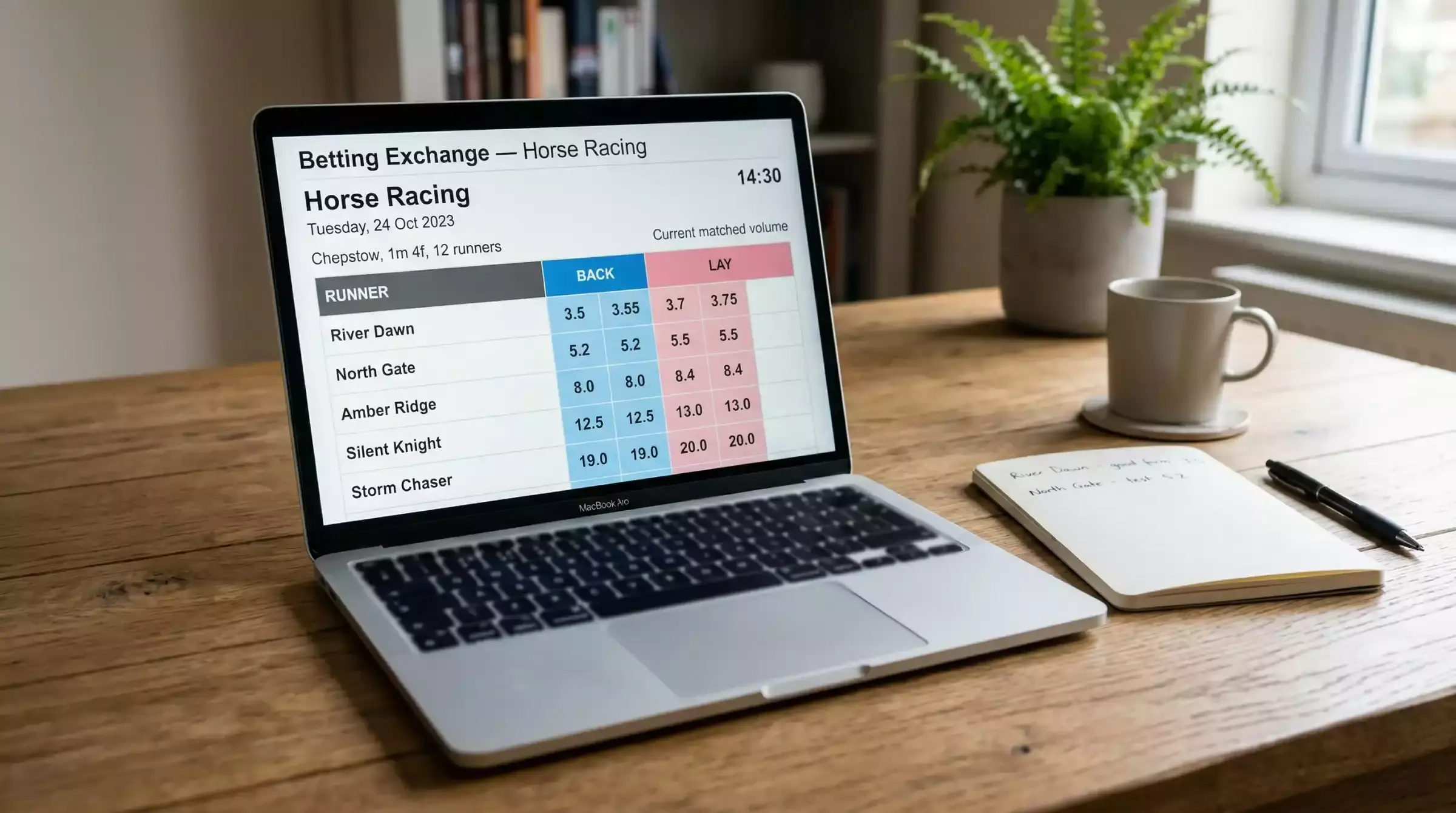

The first time I placed a lay bet, I got the maths wrong and spent the next three hours convinced I had just exposed myself to a 400-pound loss on a horse I did not even like. I had not — the liability was about 60 pounds — but the panic taught me something every exchange user needs to learn early: laying is not complicated, but it punishes carelessness. Remote horse racing betting generated 766.7 million pounds in GGY in the year to March 2025, and while exchanges account for a modest share of that total, they offer something no traditional bookmaker can — the ability to bet against a horse winning.
If you have only ever bet with conventional bookmakers, exchanges change the game. You are no longer limited to selecting winners. You can oppose them, trade positions, and in some cases find odds significantly better than anything available on the high street.
The Exchange Model: You Are the Bookmaker
At a traditional bookmaker, you bet against the house. The bookmaker sets the odds, takes your stake, and pays out if you win. On an exchange, you bet against other punters. The exchange itself is just a platform — a marketplace that matches people who want to back a horse with people who want to lay it.
Think of it like a stock exchange for racing outcomes. A backer says, “I think this horse will win — I want to buy at these odds.” A layer says, “I think it will lose — I am willing to sell at these odds.” When a backer and a layer agree on a price, the bet is matched. The exchange takes a small commission on the winning side — typically between 2% and 5% depending on the platform and your activity level.
This peer-to-peer model eliminates the overround. In a traditional bookmaker’s market, the sum of implied probabilities exceeds 100% because the bookie builds in a margin. On an exchange, the market is driven by supply and demand, and the aggregate implied probability often sits much closer to 100%. That tighter market means exchange odds are frequently better than bookmaker odds, especially on short-priced horses where the bookmaker’s margin is most visible.
The exchange also provides transparency. You can see the amount of money available at each price, which tells you how liquid the market is. A horse with 5,000 pounds available to back at 4.0 is in a deeply traded market. A horse with 20 pounds available at 4.0 is thinly traded, and your bet might move the price.
Back Bets vs Lay Bets Explained
A back bet on an exchange works identically to a bet with a bookmaker: you stake money at agreed odds, and if the horse wins, you receive the payout. The only difference is that you are being matched with another punter rather than with a corporate bookmaker.
A lay bet is the reverse. When you lay a horse, you are betting it will not win. You set a price at which you are willing to accept the risk, and if a backer matches you, the bet is on. If the horse loses, you keep the backer’s stake (minus commission). If the horse wins, you pay out at the agreed odds.
Here is where the liability calculation matters. If you lay a horse at 5.0 (decimal odds) for a 10-pound stake, your potential liability is 40 pounds — the backer’s 10-pound stake multiplied by (5.0 minus 1). That 40 pounds is reserved from your exchange balance when the bet is matched. If the horse loses, you receive the 10-pound stake and release the 40-pound reserve. If it wins, the backer gets 50 pounds (their 10-pound stake returned plus 40 pounds profit) and you lose your 40 pounds.
The critical point: your liability on a lay bet is always the stake multiplied by the odds minus one. At short prices, the liability is small. Laying a horse at 2.0 for 10 pounds means a 10-pound liability. At longer prices, the liability balloons. Laying at 10.0 for 10 pounds means a 90-pound liability. This is why experienced exchange users are cautious about laying longshots — the reward-to-risk ratio is unfavourable unless you are highly confident the horse has no chance.
Commission Structures and Effective Odds
Exchanges charge commission on net winnings, not on every bet. The standard rate varies between platforms but typically starts around 5% and can decrease to 2% or lower based on your betting volume. UK remote betting as a whole generated 2.6 billion pounds in GGY in 2025 — exchanges take their slice through commission rather than through an overround.
Commission affects your effective odds. If you back a horse at 4.0 on an exchange and it wins, your gross profit on a 10-pound stake is 30 pounds. At 5% commission, you pay 1.50 pounds, leaving a net profit of 28.50 pounds. Your effective odds drop from 4.0 to roughly 3.85. At 2% commission, the effective odds are 3.94 — almost the full price.
For layers, commission applies to the stake you collect when the horse loses. If you lay at 4.0 for 10 pounds and the horse loses, your gross profit is 10 pounds minus 5% commission, leaving 9.50 pounds. That commission rate matters more for active traders who place hundreds of bets a month, and it is worth negotiating volume-based discounts if you reach that level.
The net effect of commission is that exchange odds, while usually better than bookmaker odds before commission, are sometimes similar after commission on short-priced selections. The edge is clearest on mid-range prices (roughly 3.0 to 10.0 in decimal) where the bookmaker’s overround is widest and the exchange commission bite is relatively small.
Exchange vs Bookmaker: A Direct Comparison
I maintain accounts with three bookmakers and two exchanges, and I check odds on both before every bet. The pattern is consistent: exchanges offer better back odds about 70% of the time on UK horse racing, with the biggest advantages on races where the bookmaker’s overround is fattest — typically big-field handicaps.
The advantage of a traditional bookmaker is simplicity and promotions. Best Odds Guaranteed, free bets, price boosts, enhanced accumulators — these are not available on exchanges. BOG alone can be worth significant money over a season, because you get the higher of your price or SP without doing anything. On an exchange, there is no safety net — the price you take is the price you get.
Bookmakers also offer each-way betting as a standard product. Exchanges do not have a direct each-way market. You can bet on the place market separately (win market and place market are listed independently), but the place market is often less liquid and the available odds may not match what a bookmaker’s place terms would deliver.
Where exchanges excel is in-play betting and market flexibility. You can back a horse before the race and lay it during the race to lock in a profit — a technique called trading. If you backed at 6.0 and the horse is travelling well, you might lay at 3.0 during the race, guaranteeing a profit regardless of the result. This kind of position management is impossible with a conventional bookmaker.
Exchanges also reveal market intelligence. The volume of money matched at different prices tells you where the smart money is going. A sudden surge of backing activity at a specific price can signal stable confidence or professional interest. That data is not visible in a bookmaker’s fixed-odds market.
