
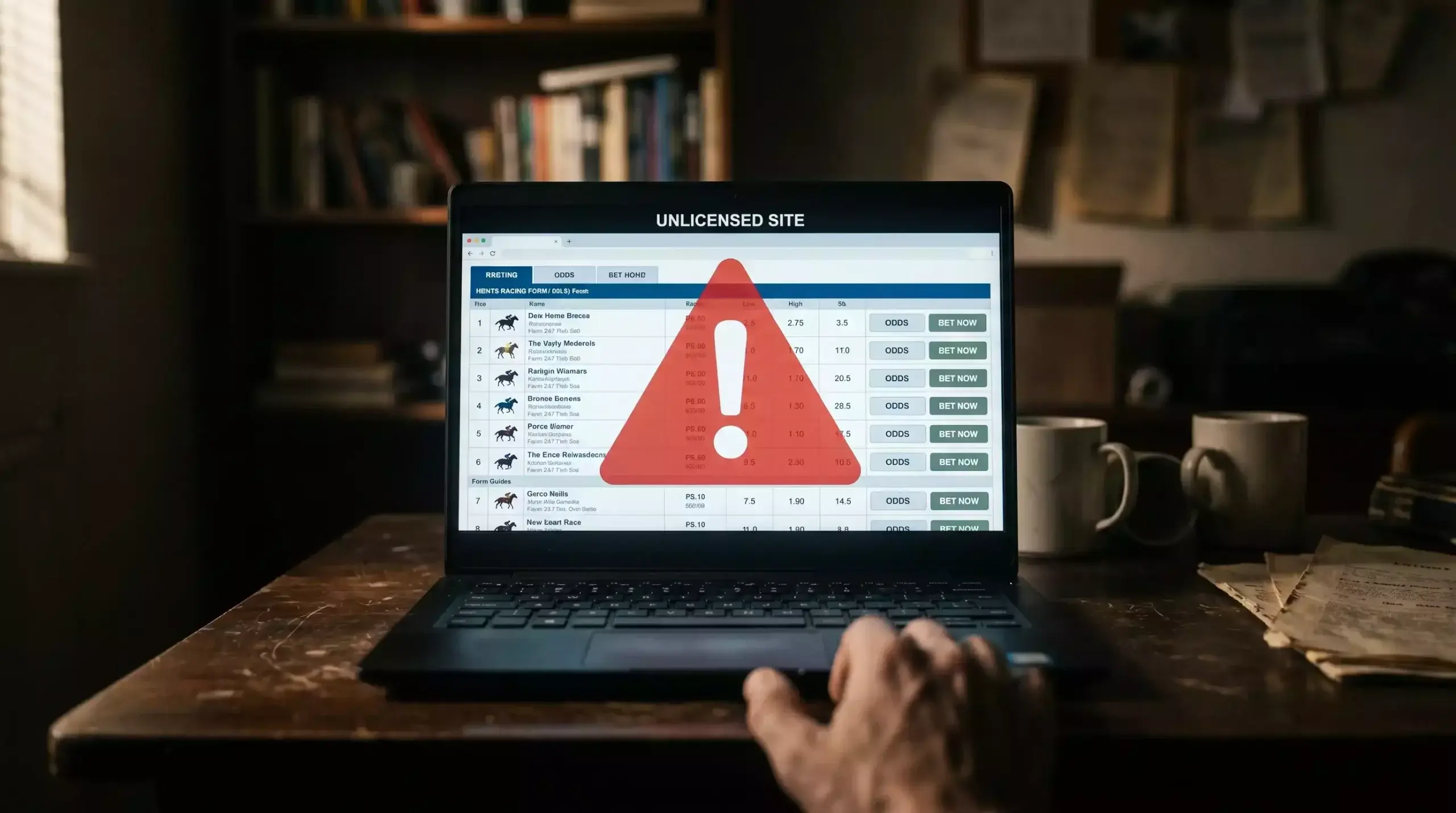

A conversation I had at Newbury last autumn stuck with me. A punter I have known for years — serious money, disciplined approach, decades of experience — told me he had moved half his betting activity to an offshore site after his main bookmaker froze his account over an affordability check. He knew it was unregulated. He knew there were no consumer protections. He did it anyway because, in his words, “I would rather risk the site disappearing than spend three weeks uploading payslips.” Unlicensed operators captured an estimated 9% of the UK online gambling market in the first half of 2025, generating approximately 379 million pounds in gross gambling yield — money that sits entirely outside the regulated framework.
This article examines the scale of the unlicensed market, what is driving punters towards it, and why it matters for anyone who bets on horse racing in Britain.
How Big Is the Unlicensed Market
The 9% market share and 379-million-pound GGY estimate comes from Yield Sec, a compliance and data firm that tracks unlicensed gambling activity targeting UK consumers. That figure covers the first half of 2025 alone, which means the annualised black-market revenue could approach 750 million pounds — nearly the entire GGY of the licensed remote horse racing betting market.
A Racing Post survey of 10,000 gamblers found that one in three punters who stake 1,000 pounds or more per transaction had used an unregulated site in the previous twelve months. That is not a fringe group — it represents a meaningful segment of higher-staking customers whose activity generates disproportionate revenue and Levy contributions when it flows through licensed channels.
The unlicensed market is not a single entity. It includes offshore bookmakers based in jurisdictions with minimal regulation (Curaçao, Costa Rica, certain Asian licensing regimes), peer-to-peer betting through social media and messaging apps, and cryptocurrency-based gambling platforms that operate without any licensing at all. The common feature is absence: no UKGC licence, no Levy contribution, no affordability checks, no self-exclusion tools, no dispute resolution mechanism.
Measurement is inherently imprecise because unlicensed activity is, by definition, not reported to regulators. The 9% figure is an estimate, and some industry observers believe the true number is higher because self-reported survey data tends to understate participation in activities that respondents know are problematic.
What Pushes Punters Towards Offshore Sites
The primary driver, according to virtually every stakeholder I have spoken to, is affordability checks. The threshold for light-touch financial checks dropped to 150 pounds in net monthly deposits in February 2025, and the friction that these checks create — account freezes, documentation requests, deposit caps — has pushed customers towards platforms that impose no such restrictions.
Nevin Truesdale, former CEO of the Jockey Club, argued that blanket checks show no discernible impact on problem gambling levels but significant evidence of driving black-market growth and damaging racing’s finances. The logic from the punter’s perspective is straightforward: if a licensed bookmaker restricts my activity, I will find one that does not. The offshore alternative is a search engine query away.
Account restrictions beyond affordability also contribute. Profitable punters — those who consistently beat the market — frequently face stake limitations or outright account closures at licensed UK bookmakers. These punters, who represent a small but vocal segment, are natural candidates for migration to unregulated platforms where winning customers are welcomed rather than restricted.
A third factor is the perception of anonymity. Offshore sites often require minimal identity verification, accept cryptocurrency deposits, and do not report activity to UK authorities. For some punters, the appeal is not about avoiding regulation but about maintaining privacy in a landscape where every deposit, withdrawal, and bet is tracked and analysed by licensed operators.
Impact on Racing Funding and the Levy
Every pound wagered with an unlicensed operator is a pound that generates no Levy contribution. The Levy — 10% of bookmaker gross profits from British racing — funds prize money, integrity services, and industry grants. The Jockey Club estimated potential losses of 250 million pounds over five years from the combined effects of affordability checks and the resulting customer migration.
Grainne Hurst, CEO of the Betting and Gaming Council, described unlicensed operators as parasites that pay no tax, care nothing about safer gambling, and contribute nothing to the Levy. The characterisation is accurate in financial terms: offshore operators free-ride on the racing product (broadcasting feeds, race results, form data) without contributing to the costs of producing it.
The knock-on effects cascade through the industry. Lower Levy receipts reduce the HBLB’s ability to fund prize money. Lower prize money reduces the incentive for owners to keep horses in training. Fewer horses mean smaller fields and weaker racing — which, perversely, makes the betting product less attractive to the remaining licensed customers, driving further turnover decline.
The integrity dimension is equally concerning. Unlicensed sites do not share data with the BHA’s integrity unit. If suspicious betting activity takes place on an offshore platform, it is invisible to the regulators monitoring for race-fixing and manipulation. The more activity migrates offshore, the less complete the integrity picture becomes — a risk that undermines confidence in the sport for everyone.
How to Verify a Site Is Licensed
An open letter signed by over 400 British racing leaders in 2026 warned that additional regulation could be a gift to the criminal underworld, and urged the government to recognise the risk that the black market poses. Whether or not you agree with the policy argument, protecting yourself from unlicensed operators is a personal responsibility.
Verification is simple. The UKGC maintains a public register of every operator holding a valid remote operating licence. You can search by company name or website address. If the operator does not appear on the register, it is not licensed to serve UK customers. Legitimate operators display their UKGC licence number in the footer of their website and within their app — typically a six-digit number preceded by the licence type.
Red flags for unlicensed sites include: no visible UKGC licence number, registration in jurisdictions with minimal gambling regulation, acceptance of cryptocurrency as the primary deposit method without fiat alternatives, no self-exclusion or responsible gambling tools, and aggressive marketing through social media channels or unsolicited messages rather than regulated advertising.
The practical advice is blunt: if a site does not hold a UKGC licence, do not use it. Your funds are not protected, your bets are not enforceable, and you have no recourse if something goes wrong. The frustrations of the regulated market — affordability checks, account restrictions, documentation requests — exist within a framework that also protects your money, ensures fair settlement, and provides a complaints mechanism. None of that exists offshore.
