
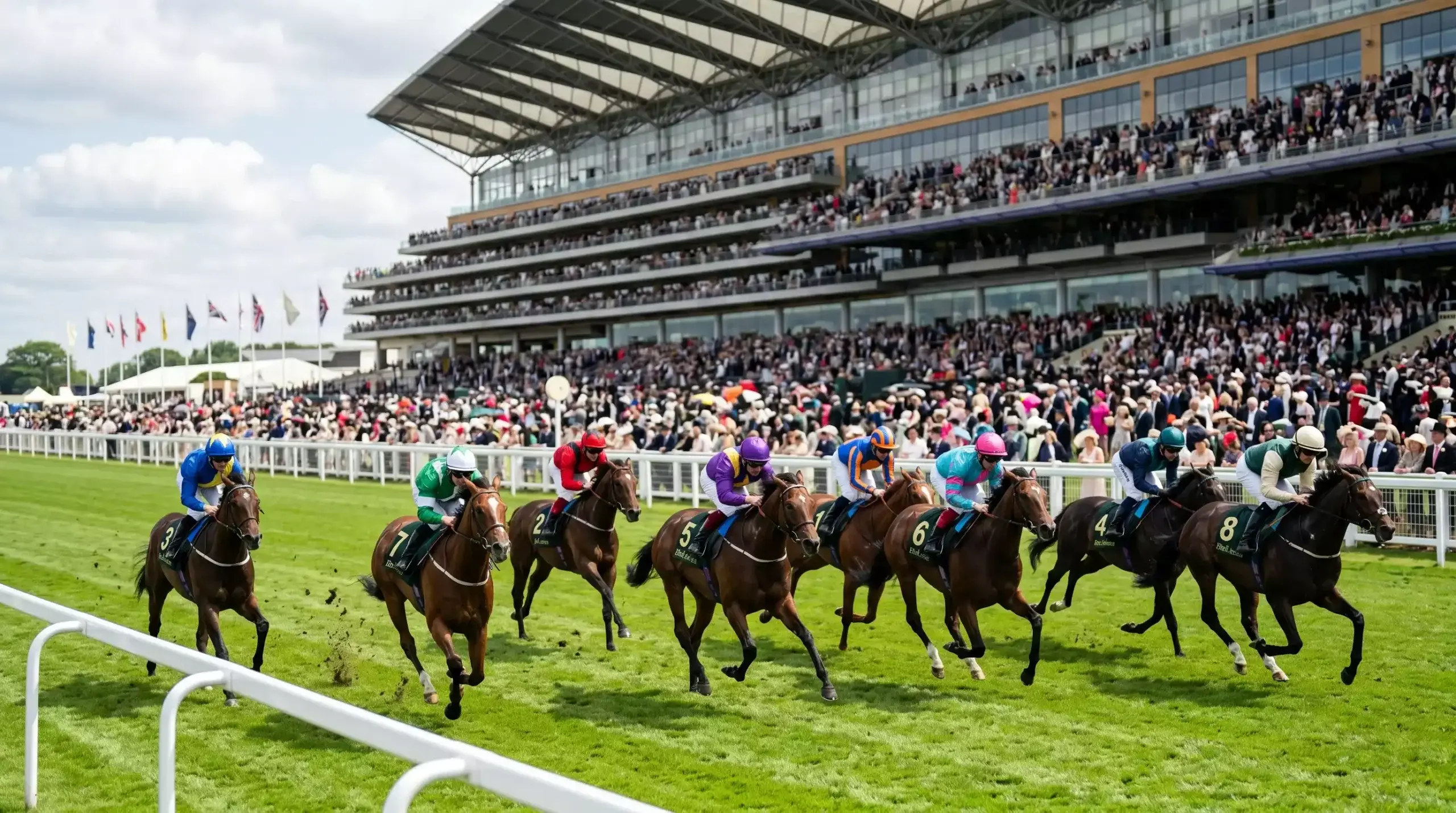

Royal Ascot is the flat season’s equivalent of Cheltenham — five days of championship racing, massive fields in the handicaps, and more betting opportunities than you can sensibly handle. I attend at least two days every year, and my approach has evolved from “bet everything that moves” to a more surgical plan focused on three or four strong selections per day. Horse racing participation among UK adults peaks between 4% and 7% during the big festival months, and June’s Royal Ascot meeting drives a significant share of that seasonal surge.
This guide covers the festival’s structure, the form factors unique to Ascot, and the betting angles I have found most productive over the years.
The Royal Ascot Card: Structure and Standout Races
Royal Ascot runs Tuesday through Saturday in the third week of June, with seven races per day across the round course and the straight course. The meeting features eight Group 1 races — more than any other flat meeting in Britain — alongside a series of highly competitive handicaps that attract huge fields and enormous betting turnover.
The standout races include the Queen Anne Stakes (Tuesday opener, one-mile Group 1), the King’s Stand Stakes (Tuesday, five-furlong sprint), the Prince of Wales’s Stakes (Wednesday, Group 1 at ten furlongs), the Gold Cup (Thursday, the two-and-a-half-mile staying championship), and the Diamond Jubilee Stakes (Saturday, six-furlong Group 1). Each attracts international runners from France, Ireland, Australia, Japan, and the US, making the form analysis more complex than at a purely domestic meeting.
The handicaps are where the betting volume peaks. The Royal Hunt Cup (one-mile handicap, Wednesday), the Wokingham Stakes (six-furlong handicap, Saturday), and the Ascot Stakes (two-and-a-half-mile handicap, Thursday) routinely attract fields of 20 to 30 runners. UK racecourse attendance topped 5.031 million in 2025, and Royal Ascot’s 300,000+ attendance across five days makes it one of the most visited sporting events of the British summer.
Draw Bias, International Runners and Going at Ascot
Ascot’s course configuration creates draw dynamics that vary by distance and going. The straight course (five furlongs, six furlongs, one mile) runs directly uphill to the finish, and draw bias depends on whether the stands rail or the far rail is riding faster. In recent years, when the ground has been on the quick side, high numbers on the straight course have shown an advantage because the stands rail gets more traffic and the ground deteriorates faster. On soft ground, the picture reverses.
The round course (races at ten furlongs and beyond) starts with a long sweeping right-hand bend before a three-and-a-half-furlong straight. Draw is less influential here because the field has time to settle before the turn, but pace — how fast the early fractions are run — becomes critical. Front-runners that get to the bend first can dictate, while hold-up horses need to navigate traffic on the turn.
International runners add a layer of complexity. French and Irish raiders are well represented at Royal Ascot, and their form can be difficult to assess against UK benchmarks. French time figures and Irish race ratings do not directly translate to British ratings, and the going at Ascot (typically good to firm in June) may differ from what the international raiders have experienced in their prep races. However, international runners at Royal Ascot have a strong record in the Group 1 events, and dismissing them because of unfamiliar form is a mistake that domestic-focused punters make too often.
Going at Ascot in June is typically good to firm, but the meeting has experienced everything from firm to soft in recent years. The Berkshire climate is unpredictable in early summer, and significant rain in the days before the meeting can transform the ground. Monitoring the going forecast is essential — a horse aimed at Royal Ascot on the basis of fast ground may be a very different proposition if the heavens open.
Royal Ascot Betting Angles
My most consistent approach to Royal Ascot is each-way betting in the big handicaps. The fields are large, the place terms are generous (often extended to five or six places by bookmakers), and the competitive nature of these races produces results at big prices. Backing two or three each-way selections per handicap at 16/1 or bigger has been my most profitable Royal Ascot strategy across the past five years.
In the Group 1 races, I focus on price rather than prediction. These races have small fields and strong-form principals, and the market is usually efficient — the favourite wins around 35-40% of the time, which is close to fair value at typical favourite prices of 2/1 to 7/2. The angle is not backing the favourite but opposing it — identifying when the favourite is vulnerable (wrong ground, wrong pace scenario, first run at the distance) and backing the second or third in the market at more generous odds.
Two-year-old races at Royal Ascot are uniquely tricky. Several races on the card — the Coventry Stakes, the Queen Mary, the Norfolk — feature juveniles with limited form, and the market for these races is driven heavily by stable reputation and breeding. Late market moves are more informative in these races than in any other context at the meeting. A horse that shortens from 12/1 to 7/1 in the last fifteen minutes before a two-year-old race is receiving money from people with private information, and the signal is worth noting.
Finally, the Gold Cup on Thursday is a race that repays patience. Staying races over two and a half miles on the flat attract a specialist audience of punters who study stamina indicators closely. The market is often less efficient than for the sprint and mile events because fewer casual punters engage with the staying division. If you know the staying form — which horses have won or placed over extreme distances, how they handle the Ascot hill, whether the pace is likely to be true or tactical — the Gold Cup can produce genuine value.
