
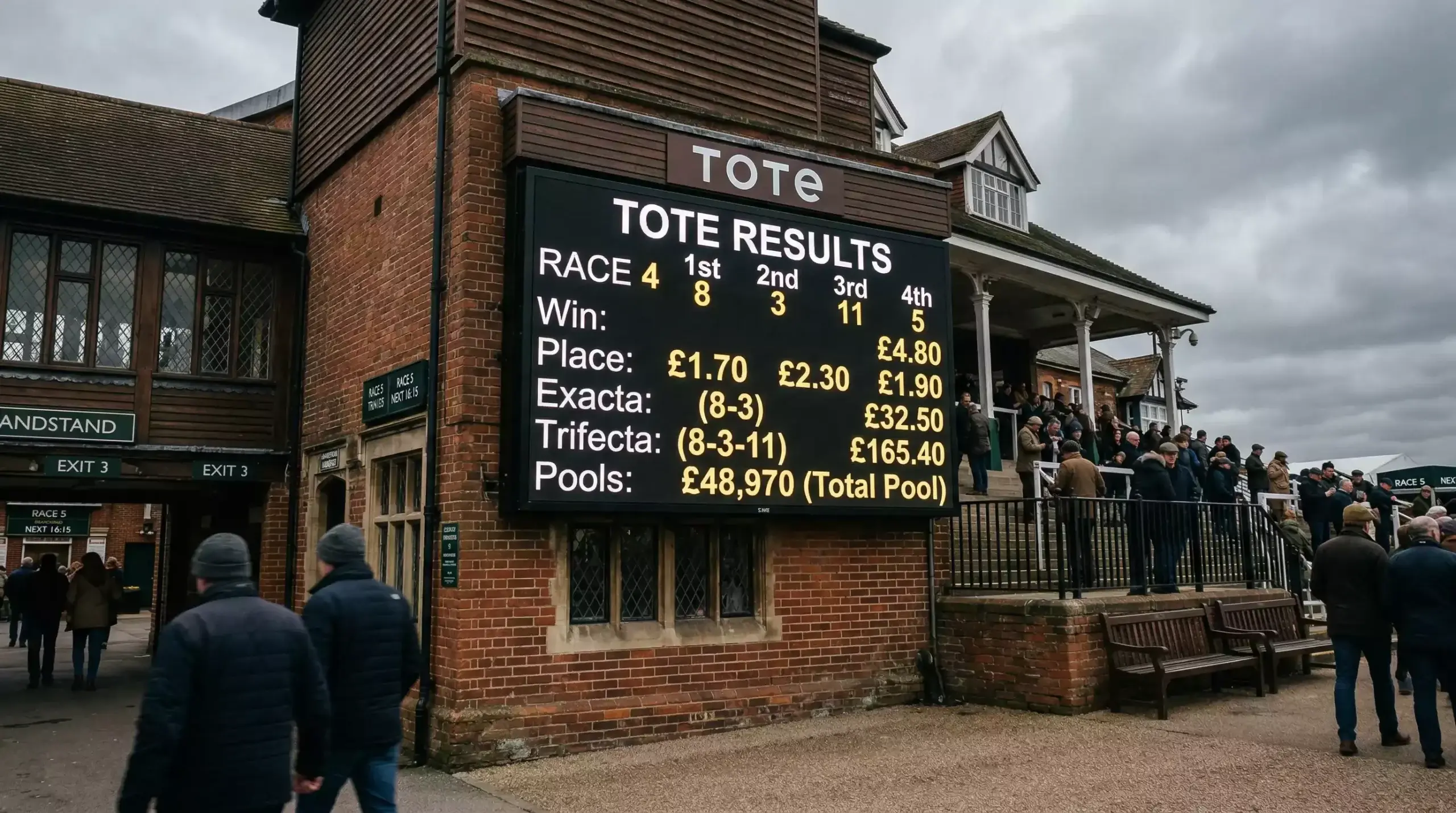

I once collected a Placepot dividend of 387 pounds from a two-pound stake at Ascot. Six races, six placed horses, and a pool that had been swollen by thousands of losing tickets. That payout was bigger than anything I had won from fixed-odds betting that entire month — and I had not even picked a single winner. That is the beauty and the strangeness of pool betting: you are not playing against a bookmaker’s margin but sharing a pot with every other punter who entered, and the payoff depends on how many of them got it wrong.
The Tote is Britain’s pool betting operator, and it works on a completely different model from the fixed-odds bookmakers that dominate the market. Remote horse racing betting contributed 766.7 million pounds in gross gambling yield in the year to March 2025, and while the Tote’s share is a fraction of that total, its products offer angles that fixed-odds betting simply cannot replicate.
Fixed Odds vs Pool: How the Tote Is Different
When you place a fixed-odds bet with a bookmaker, the price is locked in at the moment of the bet. Your potential return is fixed and does not change regardless of what other punters do. If the horse wins, the bookmaker pays you at the agreed odds. The bookmaker absorbs the risk and builds a margin (the overround) into its prices.
Pool betting flips that model. When you bet into a Tote pool, your money joins a collective pot. The Tote takes a deduction — its operating margin — and the remaining pot is divided among all winning tickets. The payout, called the dividend, is determined after the race based on how much money was in the pool and how many people backed the winner. You do not know what your return will be until the race is over.
This creates an interesting dynamic. If a heavily backed favourite wins, the dividend will be small because many tickets share the pool. If a lightly backed outsider wins, the dividend can be enormous because very few tickets share the pot. In practical terms, the Tote tends to pay worse than fixed odds on short-priced horses and better than fixed odds on longshots — precisely because the crowd piles money on favourites, leaving more of the pool for those who picked the overlooked runner.
The Tote’s standard deduction varies by bet type but typically sits between 13% and 28%. That is higher than a competitive bookmaker’s overround on a single race, which is why fixed-odds betting dominates for straightforward win and place bets. Where the Tote becomes interesting is in its exotic products — Placepot, Quadpot, Jackpot, and Scoop6 — where the pool model creates payouts that fixed-odds markets cannot match.
Tote Win, Place, Exacta, Placepot, Jackpot
British racing operates across 59 racecourses and supports over 20,000 direct jobs. The Tote is present at virtually every meeting, offering a range of pool bets from the simple to the complex. Here is what each product involves.
Tote Win — the simplest pool bet. You pick a horse to win. If it wins, you receive a share of the win pool. The minimum stake is usually two pounds. For well-backed favourites, the Tote Win dividend is often lower than SP. For outsiders, it can be higher.
Tote Place — you pick a horse to finish in the places (the number of places depends on the field size). The place pool is separate from the win pool, and dividends are declared for each placed horse individually.
Tote Exacta — predict the first and second in correct order. The Exacta pool is separate and the dividends can be substantial because exact-order predictions are difficult. A combination Exacta covers both possible orders of your two selected horses, at double the stake.
Placepot — the flagship Tote product. You select a horse to place in each of the first six races at a meeting. All six must place for your ticket to share the dividend. Because the Placepot runs across six races and requires consistency rather than outright winners, it rewards solid form analysis. Pools regularly exceed 100,000 pounds at major meetings, and dividends of several hundred pounds from a small stake are common.
Quadpot — the same as the Placepot but covering only the third, fourth, fifth, and sixth races. It is easier to navigate because there are fewer legs, and the minimum stake is lower, but the pools and dividends are correspondingly smaller.
Jackpot — pick the winner of each of the first six races. All six must win, not just place. This is significantly harder than the Placepot and the dividend can run into thousands or even tens of thousands of pounds. Rollovers occur when no one picks all six winners, and the accumulated pool carries forward to the next Jackpot meeting.
Scoop6 — a Saturday-only pool covering six televised races. You pick a winner in each. If you win, you share the main pool and qualify for a bonus round the following Saturday where you must pick the winner of a specified race to claim the bonus fund. The Scoop6 bonus has occasionally topped one million pounds.
How Tote Dividends Are Calculated
The Tote dividend calculation is straightforward in principle. Take the total pool, subtract the operator deduction, and divide the remainder by the number of winning unit stakes. The result is the dividend per one-pound unit.
For example, suppose a Tote Win pool totals 50,000 pounds. The deduction is 14%, leaving 43,000 pounds. If 8,600 one-pound units were placed on the winning horse, the dividend is 43,000 divided by 8,600 — roughly 5.00 pounds per one-pound stake. A two-pound stake returns 10.00 pounds.
In exotic pools like the Placepot, the calculation cascades. After the first race, the share of the pool allocated to winning tickets rolls into the second race. After the second race, the surviving share rolls again. By the sixth race, the number of surviving tickets can be very small, concentrating the pool and inflating the dividend. On a day where several outsiders place in the first few legs, casual punters’ tickets get eliminated early, and the remaining tickets share a larger proportion of the original pool.
One subtlety worth knowing: the Tote guarantees a minimum dividend on Win and Place bets (currently the equivalent of SP odds minus a small margin, or the pool dividend, whichever is higher). This protects you from the rare situation where so much money backs the winner that the pool dividend is derisory.
Pool Betting Angles: When the Tote Beats Fixed Odds
I use the Tote strategically for three specific situations, and I ignore it for everything else. The first is big-field handicaps where I am backing a horse at 12/1 or longer. These are exactly the races where the Tote dividend tends to exceed SP, because the pool is dominated by money on the front of the market and the outsider’s share of the pot is proportionally larger.
The second is the Placepot at meetings where I have strong place opinions. The Placepot does not require winners — just placed horses. If I can identify likely place finishers in each of six races (using form, going, and trainer patterns), the Placepot offers a return structure unavailable from fixed-odds betting. I typically use perm entries — two or three horses in the trickier races, one banker in the races where I have strong confidence. This increases the cost but dramatically improves the survival rate across six legs.
The third is when the Scoop6 bonus fund has rolled over several times and sits at a life-changing figure. The expected value of a Scoop6 entry increases with the bonus fund because the bonus is essentially free money added to the pot. When the bonus exceeds 500,000 pounds, I will put in a few lines at modest stakes.
For standard win bets on favourites or mid-priced horses, fixed-odds bookmakers are almost always better value than the Tote. The deduction rate on the Tote Win pool is higher than a competitive bookmaker’s effective margin, and BOG promotions give you further protection on the fixed-odds side. Pool betting is a specialist tool, not a replacement for fixed-odds wagering.
