
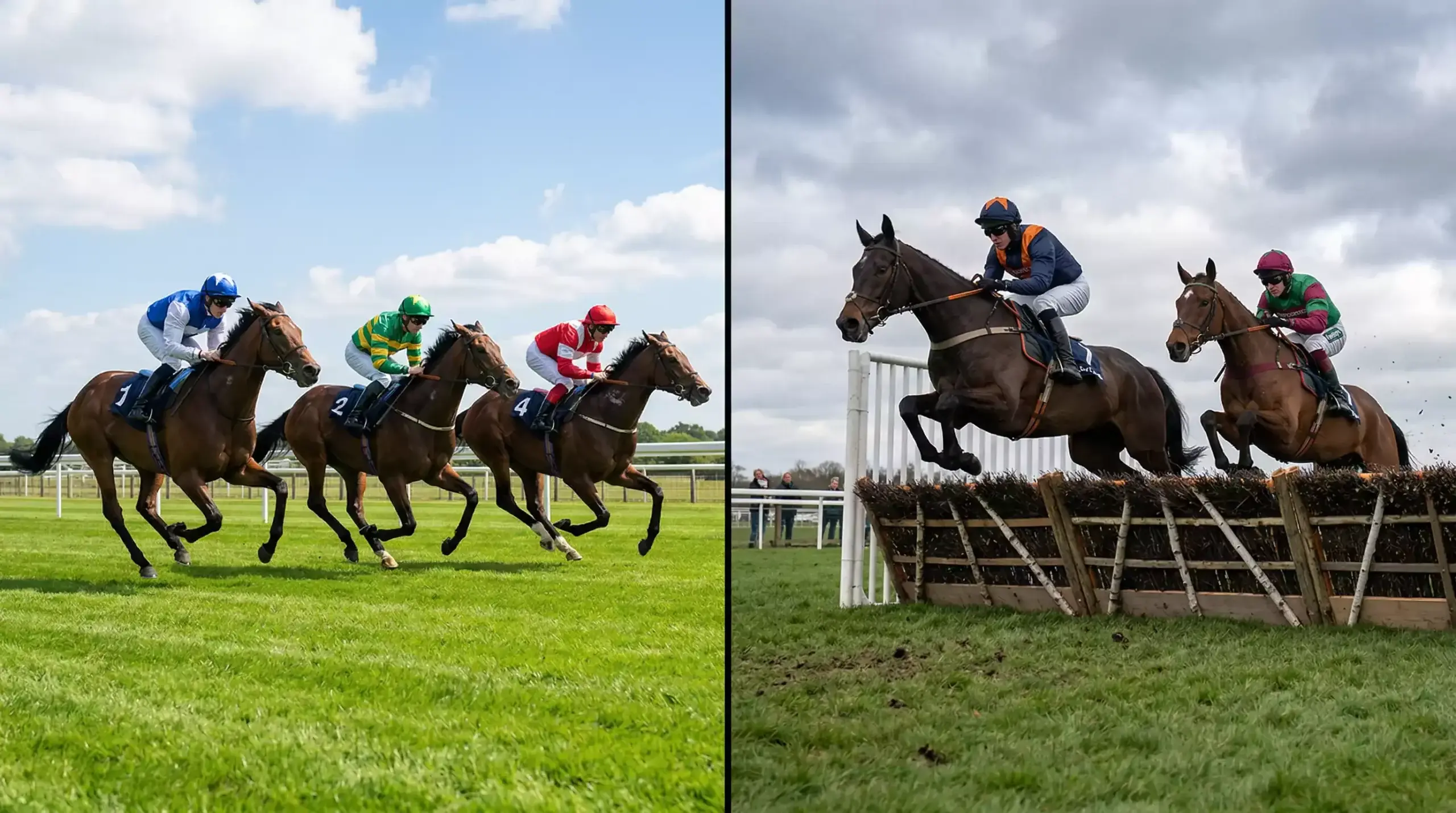

I spent my first two years betting almost exclusively on National Hunt racing — the drama, the big fences, the winter afternoons. When I finally turned my attention to the flat season, I assumed the same principles applied. They do not. My first month betting flat racing produced a 30% loss on turnover because I was still thinking like a jumps punter: overvaluing stamina, ignoring the draw, treating the going as a secondary factor rather than a primary one. UK racecourse attendance topped 5.031 million in 2025 — the first time it had crossed five million since 2019 — and a decent share of those visitors watch both codes without realising how different the betting considerations are.
Flat racing and National Hunt share a sport, but they demand different analytical frameworks. This article lays out the structural differences and the specific betting angles each code creates.
Season, Surface and Race Structure at a Glance
The flat turf season in Britain runs roughly from April to October, though all-weather racing fills the calendar year-round at tracks like Lingfield, Wolverhampton, Kempton, Newcastle, Chelmsford, and Southwell. National Hunt racing dominates the winter months, peaking between October and April with the Cheltenham Festival and the Grand National at Aintree as its centrepieces.
That seasonal split is more than a scheduling detail. Flat horses tend to have shorter careers at the top level — some retire to stud after just two or three seasons of racing. National Hunt horses develop more slowly, often not reaching their peak until age seven, eight, or even older. This has a direct betting implication: form from three years ago is largely irrelevant for a flat sprinter but can be highly informative for a seasoned chaser.
Surface is the other dividing line. Flat racing takes place on turf or synthetic all-weather surfaces. National Hunt racing is exclusively on turf, and the going plays a more dramatic role because the distances are longer and the jumping effort amplifies the effect of soft or heavy ground. British racing’s total prize fund reached 194.7 million pounds in 2025, split between both codes, and the quality of fields at the top level is comparable — the difference lies in how you read them.
Race distances on the flat range from five furlongs (about 1,000 metres) to two miles four furlongs in marathon events like the Ascot Gold Cup. National Hunt distances start at about two miles for hurdle races and extend beyond four miles for the longest steeplechases. Longer races introduce more variables — pace collapses, jumping errors, stamina failures — which means the volatility of outcomes is structurally higher in jumps racing.
Field sizes differ too. Flat handicaps can attract twenty or more runners, especially in the big-field events at York, Goodwood, and Ascot. National Hunt fields are generally smaller because the attrition rate from falls and non-completions thins the active population. This matters for each-way betting: larger fields mean more places paid and, often, more generous place terms.
Betting Angles Specific to Flat Racing
One afternoon at Newmarket, I watched a horse drawn in stall one win a seven-furlong handicap by a neck while a visually superior horse, drawn in stall eighteen, got stuck wide on the turn and finished fourth. The draw bias at certain courses on certain ground conditions can override ability. That is a dynamic unique to flat racing, because jumps races do not use starting stalls.
Draw analysis is the first flat-specific angle. Courses like Chester, Beverley, and Musselburgh show persistent low-draw biases on certain going. At Chester’s tight left-handed track, a horse drawn in stall one or two in a five-furlong sprint has a measurable advantage over a horse drawn in stall ten. At Ascot’s straight mile, the bias shifts with the ground: when the rail is fresh and the going is quick, high numbers can dominate. Tracking draw statistics by course, distance, and going is tedious work, but it surfaces genuine edges that most casual punters ignore.
Speed figures — ratings that quantify a horse’s performance adjusted for conditions — are more reliable on the flat because the absence of jumping removes a major source of random interference. A horse that clocked a fast time on good ground at Newmarket is giving you a cleaner data point than a chaser that won by ten lengths at Haydock but might have been flattered by rivals falling.
Two-year-old racing creates a distinct sub-market. Unraced juveniles debut with no public form, so the market relies heavily on trainer reputation, breeding, and gallops intelligence. Prices can swing wildly in the final ten minutes before a two-year-old maiden, and that volatility is an opportunity for punters who monitor market movements rather than relying on the morning tissue prices.
Betting Angles Specific to National Hunt
The single biggest adjustment I made when I started winning at jumps racing was simple: I stopped ignoring the jumps. It sounds obvious, but most beginners assess a National Hunt horse the same way they assess a flat horse — by speed and form figures. In reality, jumping ability is a distinct skill, and it separates winners from fallers every day of the season.
A horse’s jumping profile — how cleanly it gets over hurdles or fences, whether it gains or loses lengths at obstacles, how it handles heavy ground at takeoff points — is a critical layer of analysis. Videos of previous runs are more valuable in jumps racing than on the flat, because you can visually assess jumping technique in a way that numbers alone cannot capture.
Trainer form carries more weight in National Hunt racing than on the flat. The best jumps trainers — operations that routinely send out horses in peak condition for the big festivals — generate strike rates that significantly outperform the field. When a top jumps trainer targets a specific race with a horse that fits the conditions, the market pays attention, and so should you.
Going is amplified at National Hunt distance. A horse with six career wins on soft ground that encounters good-to-firm turf is not just disadvantaged — it may be genuinely unsuited. The energy cost of jumping on fast ground versus yielding ground alters a race fundamentally. Cross-referencing a horse’s going record with the day’s official ground is non-negotiable in jumps betting.
Finally, the attrition rate in steeplechases means that place betting and each-way strategies have a different complexion. In a sixteen-runner novice chase, it is not unusual for three or four horses to fall or unseat. That natural attrition boosts the probability of place finishes for horses that stay on their feet, which makes each-way betting on consistent jumpers a structurally sound approach.
Dual-Purpose Horses and Crossover Opportunities
Every autumn, a batch of flat horses transition to National Hunt racing. Some of these dual-purpose animals carry form that the jumps market undervalues because it was achieved on the flat and does not directly translate. I have made some of my best bets on ex-flat horses making their hurdling debuts, because the flat form gives you a speed baseline that the jumps-focused market sometimes overlooks.
The classic profile is a flat stayer — a horse rated in the mid-90s to low 100s on the flat, effective at a mile and a half or further, bred with some jumping pedigree on the dam’s side. When that horse turns up in a novice hurdle, the market often prices it cautiously because it has no jumps form. But if it has been schooling well at home (trainer quotes or racing press reports can reveal this), the flat speed alone can be enough to dominate modest hurdlers who lack a turn of foot.
The reverse crossover is rarer but does exist: jumps-bred horses running on the flat during the summer. These tend to be less competitive in pure speed terms, but in long-distance flat handicaps on soft ground — the kind of stamina tests that take place at Ascot or Goodwood in autumn — they can outrun their flat ratings.
For punters, the crossover window between seasons — roughly September to November — is a fertile period. Markets are less efficient when a horse straddles two codes because the form-book does not always connect the dots cleanly between flat and jumps data.
