
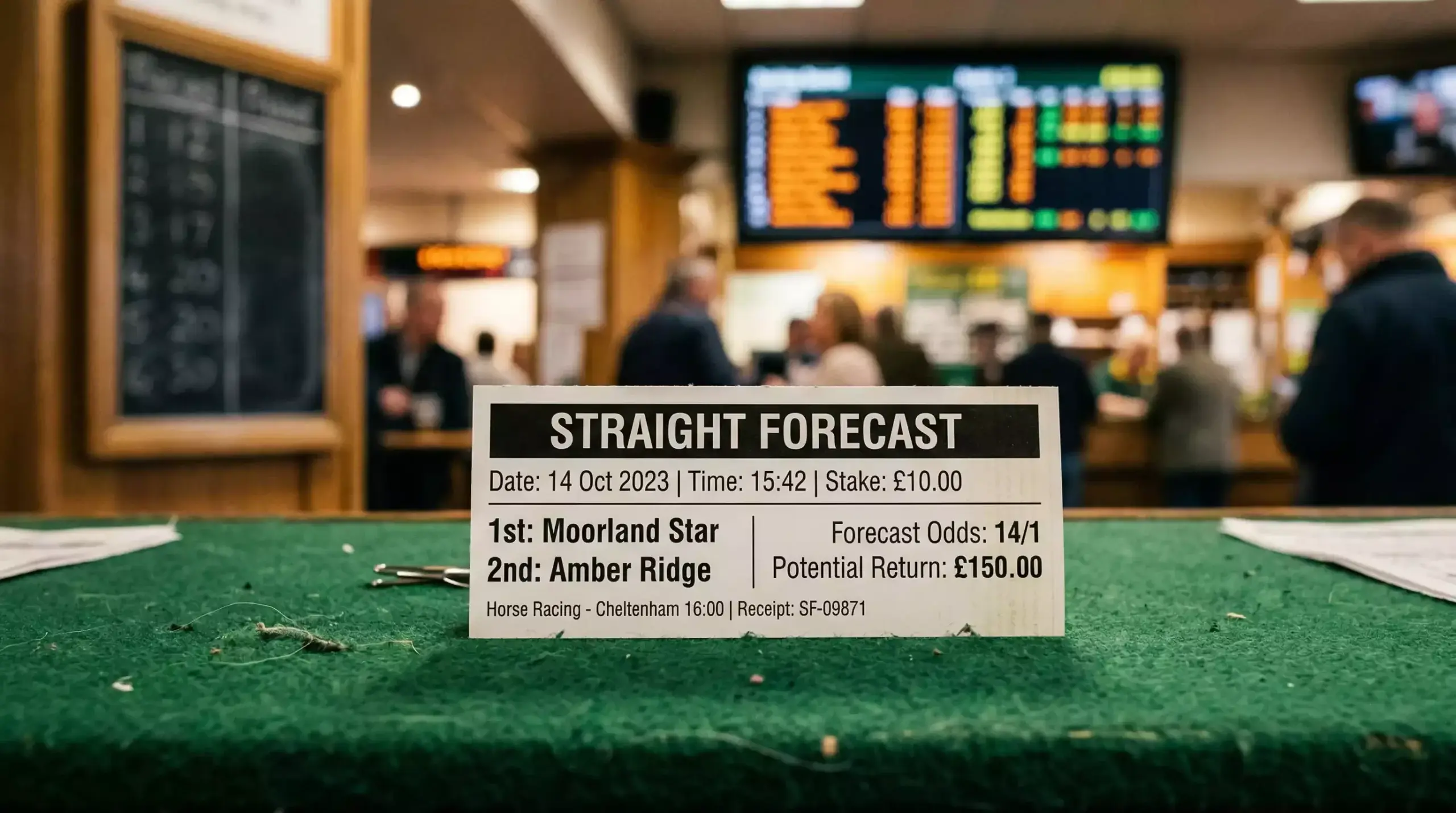

The biggest single return I ever had on a horse racing bet was not a 50/1 winner — it was a tricast at Wolverhampton on a wet Wednesday evening. Three horses, exact order, in a 12-runner handicap. The Computer Tricast dividend was just over 900 pounds for a two-pound stake. I did not pick those three through some flash of genius; I identified two horses I thought would fight out the finish and added a third who had run well over course and distance. Forecasts and tricasts reward precision, and when you get them right, the payouts reflect the difficulty. Remote horse racing betting generated 766.7 million pounds in GGY in the year to March 2025, and exotic bets like forecasts and tricasts are a small but enthusiastic part of that market.
This article breaks down how each type works, how the payouts are calculated, and when they offer value rather than just an expensive lottery ticket.
Straight, Reverse and Combination Forecasts
A forecast bet predicts which two horses will finish first and second. The simplest version — the straight forecast — requires you to name both horses in the correct order: Horse A first, Horse B second. If they finish in the wrong order, the bet loses.
A reverse forecast covers both possible orders of your two selections. Horse A first and Horse B second, or Horse B first and Horse A second. Either result wins the bet. Because it covers two outcomes, a reverse forecast costs twice the unit stake — a one-pound reverse forecast is actually two one-pound bets.
A combination forecast extends the concept to three or more selections. If you select Horses A, B, and C, a combination forecast covers every possible pairing in every possible order: A-B, B-A, A-C, C-A, B-C, C-B — six bets in total from three selections. With four selections, you get twelve bets. The cost scales rapidly: with five selections, you are placing twenty separate forecast bets. Combination forecasts are useful when you have strong opinions about several horses but cannot separate them into a definitive order.
All forecasts require a minimum of three runners in the race. If the field has fewer than three declared runners, forecast betting is not available. In practice, forecasts are most interesting in races with at least eight runners, where the number of possible first-and-second combinations is large enough that the market underprices certain outcomes.
One practical tip: forecast bets with traditional bookmakers are usually settled at the Computer Straight Forecast (CSF) dividend rather than at fixed odds. This means the payout is determined by a formula after the race, not by the odds displayed when you place the bet. I will explain CSF in the next section.
Computer Straight Forecast: How the Payout Is Decided
The Computer Straight Forecast is a mathematical formula that calculates the forecast dividend based on the starting prices of the first and second horses. It was introduced in 1977 to replace the previous system of manually calculated dividends, and it remains the standard settlement method for forecast bets with UK bookmakers.
The CSF formula is complex, but the principle is straightforward: it multiplies the difficulty of predicting both the winner and the runner-up. If the first two home are both longshots, the CSF is large. If they are the first and second favourites in a small field, the CSF is small. The formula accounts for the overround in the market, so the payout is not simply the product of the two SPs — it adjusts for the market structure.
UK remote betting as a sector generated 2.6 billion pounds in GGY in 2025, with bookmaker forecasts settled primarily through the CSF mechanism. As a rough guide, if the winner is 6/1 and the second is 8/1 in a 12-runner race, the CSF might pay somewhere around 80/1 to 120/1. If the winner is 2/1 and the second is 3/1, the CSF might be 12/1 to 18/1. These are approximations — the actual CSF depends on the full market structure, not just the two prices.
Some bookmakers offer fixed-odds forecasts as an alternative to CSF settlement. With fixed odds, you see the price before you bet and know exactly what you will receive. Fixed-odds forecasts tend to be less generous than CSF on average because the bookmaker builds in a wider margin, but they provide certainty. If you prefer to know your return at the point of betting, fixed odds are the way to go. If you are happy to accept the post-race calculation, CSF sometimes delivers larger payouts.
Tricast Betting: Predicting the First Three
A tricast bet predicts the first, second, and third horses in exact finishing order. It is the hardest standard bet type in horse racing and produces the largest payouts from small stakes. Tricasts require a minimum of eight declared runners — fewer than that, and the bet type is not offered.
Like forecasts, tricasts come in straight and combination versions. A straight tricast names three horses in the exact order: A first, B second, C third. A combination tricast covers every possible ordering of your three selections — six permutations — so the cost is six times the unit stake. With four selections, a combination tricast covers 24 permutations. Five selections produce 60. The cost escalates quickly.
Tricast payouts are settled using the Computer Tricast formula, which works on the same principle as the CSF but compounds the difficulty of predicting three finishers. The dividends can be enormous. In a big-field handicap where the first three home are all priced at 10/1 or longer, Computer Tricast returns in excess of 5,000/1 are not unheard of. Even more routine outcomes — a 4/1 winner, a 6/1 second, and a 10/1 third — can produce returns of several hundred to one.
The practical challenge is obvious: predicting the exact first three in a competitive horse race is extraordinarily difficult. The randomness of racing — pace scenarios, jumping incidents, ground conditions, jockey decisions — means that even a strong analysis of the principals leaves the third-place finisher as largely a matter of chance in many races.
When Forecasts and Tricasts Offer Value
Forecasts and tricasts are not value bets in the conventional sense. The overround on these markets is significantly higher than on win or place betting, and the bookmaker’s edge compounds because you are making a multi-outcome prediction. But there are specific situations where the structure of the race creates opportunities.
The first is in small-field races with a clear top two. If a six-runner conditions chase has two horses that are head and shoulders above the rest, a reverse forecast on those two costs relatively little and the CSF, while modest, is more predictable than in a large-field handicap. You are essentially betting that form will hold — and in small-field conditions races, it often does.
The second is in large-field handicaps where you have identified three horses with strong course-and-distance form on today’s going. The combination tricast in a 20-runner race is expensive (six bets), but the potential payout is huge because the CSF formula amplifies the dividend in deep fields. The key is to have a genuine reason for selecting each horse, not just a random three names.
The third is as a complement to each-way betting. If you are backing a horse each-way in a handicap, adding a small forecast or tricast alongside can significantly increase the return on a good day without dramatically increasing the total outlay. A two-pound each-way (four pounds total) plus a one-pound straight forecast (one pound total) costs five pounds. If your horse wins and your second selection runs into the places, you collect on the each-way and the forecast — a combined return that can be multiples of what either bet produces alone.
The worst use of forecasts and tricasts is as a substitute for win or each-way betting. The hit rate is inherently low, and unless you are treating them as a small-stakes supplement to your main bets, they will drain your bankroll steadily.
