
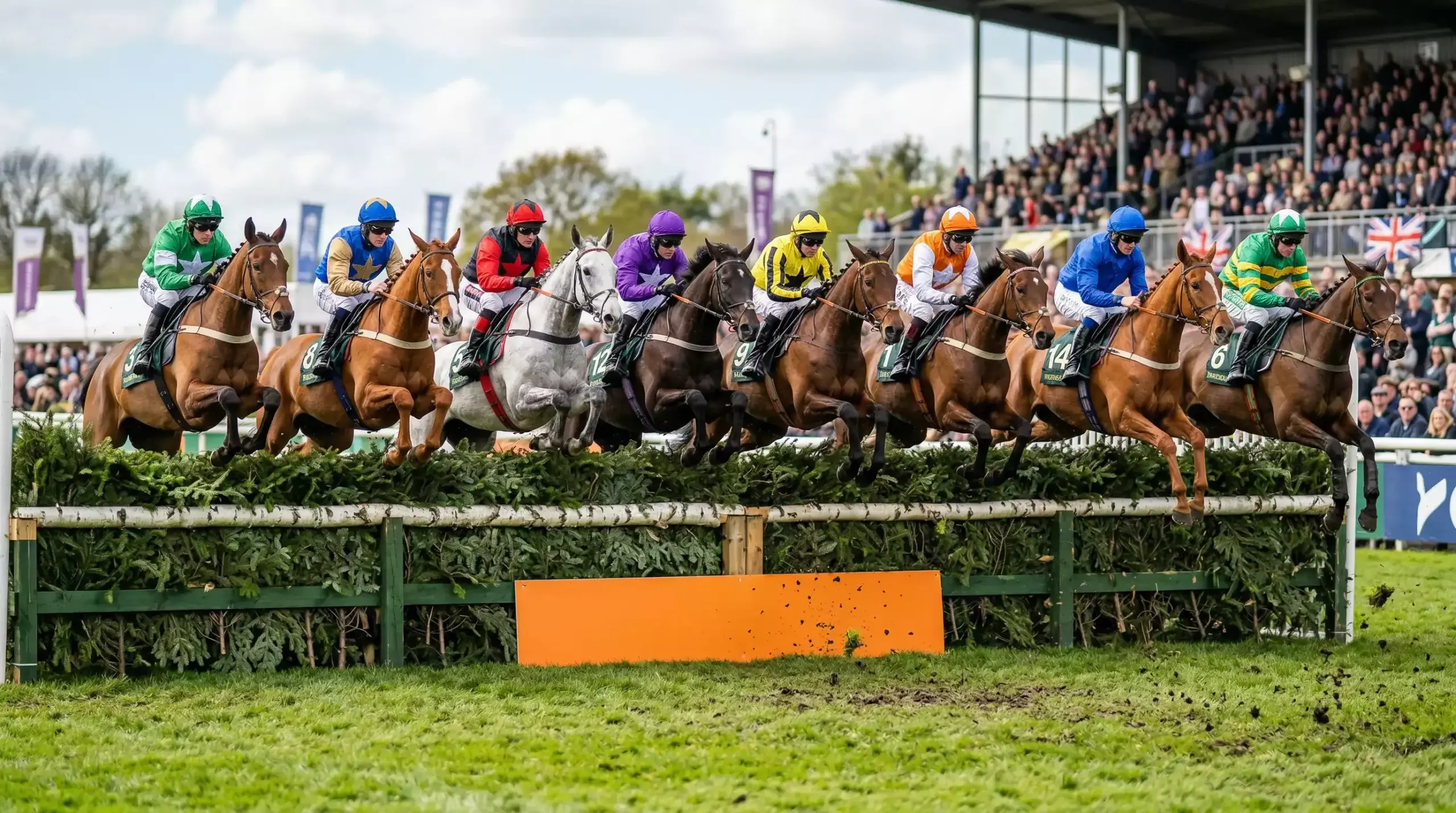

The first Grand National I ever bet on seriously — not just a sweep at work, but an actual studied wager — was 2018. I spent two weeks narrowing a field of 40 runners down to four and backed two of them each-way. Neither placed. The winner was a 33/1 shot that ticked precisely one of my criteria. That afternoon confirmed what everyone who studies this race already knows: the Grand National is a uniquely chaotic betting event, and the chaos is the whole point. Up to 350 million pounds in wagers flow through this single race each year, making it the largest individual betting event in British horse racing.
Understanding how to approach the National’s betting market — rather than throwing darts at a list of 40 names — separates the punters who lose less from those who lose more.
The Race in Numbers: Field, Distance, History
The Grand National is a handicap steeplechase over approximately four miles and two furlongs at Aintree, featuring 30 fences including the famous Becher’s Brook and The Chair. The maximum field size is 40, though recent renewals have seen the full quota. The race has been run annually since 1839, with interruptions only during wartime and the Covid period.
The handicap element is critical. Weights are assigned based on official ratings, with the top weight carrying around 11st 10lb and the bottom weight around 10st. The spread of roughly 25 pounds across the field creates a race where form analysis alone cannot separate runners — the handicapper’s assessment flattens ability differences, at least in theory.
Historically, winners have come from across the handicap. Favourites have a win rate of roughly 12-15% in the Grand National — significantly lower than the 30% baseline for favourites in UK racing generally. This is a function of field size, the extended distance, and the jumping challenge. A horse can be the best on form and still fall at the first fence.
The attrition rate is a defining feature. In a typical renewal, between 15 and 25 horses complete the course out of 40 starters. Falls, refusals, pulled-up horses, and unseated riders thin the field dramatically. That attrition underpins the each-way value — with only 15-25 finishers from 40 starters, a horse that stays on its feet has a higher probability of placing than raw form analysis would suggest. Racecourse attendance in Britain topped 5.031 million in 2025, and the National alone draws more casual punters than any other meeting of the year, with 68% of visitors at British racecourses classified as casual or first-time attendees.
How Grand National Odds Are Shaped
Grand National odds are formed differently from a standard Saturday handicap. The sheer number of runners compresses the market — in a 40-runner field, even the favourite is typically priced between 6/1 and 10/1, reflecting the difficulty of winning. The book percentage (total implied probability) for a Grand National market often exceeds 150%, meaning the bookmaker’s overround is wider than in smaller-field races.
The market is also shaped by public money. The Grand National is the one race where millions of once-a-year punters bet based on names, colours, and tips from colleagues. That volume of uninformed money skews prices. Horses with appealing names or media coverage attract disproportionate backing, which shortens their odds beyond what form justifies. Conversely, unfashionable horses with strong profiles can drift to generous prices because the recreational market does not know them.
For serious punters, the inefficiency in the Grand National market is not about finding the winner — it is about identifying horses whose true probability of placing exceeds what their odds imply. In a race with this much randomness, the each-way angle is more reliable than the win angle. Backing a horse at 25/1 each-way when you assess its true place probability at better than the implied level is a consistently sound approach.
Betting Strategy for a 40-Runner Handicap Chase
My Grand National process starts with elimination rather than selection. I remove horses that fail any of four criteria, and whatever survives gets a closer look. The four filters are: proven stamina at three miles or further over fences, experience of handling large-field races (10+ runners), at least two runs in the current season to confirm fitness, and an age between eight and eleven (the historical sweet spot for National winners).
That filtering process usually cuts the field from 40 to somewhere between 12 and 18. From there, I look at jumping ability — specifically, how the horse has handled the Mildmay course at Aintree or similar tests at Haydock and Warwick. Aintree’s fences are unique, and previous course experience is a genuine advantage. Horses running the National for the first time face a jumping test unlike anything they have encountered, and the fall rate among debutants is higher.
Weight is a factor but not a deal-breaker. The historical data shows no strong correlation between carried weight and finishing position in the Grand National — the handicapper does a reasonable job of levelling the field. What matters more is whether the horse is well handicapped relative to its recent form, which is a subtler assessment than just reading the weight column.
I always back each-way rather than win-only. The standard Grand National each-way terms pay on the first four places at one-quarter of the odds (some bookmakers extend to five or six places as a promotion). With 40 runners and a high attrition rate, the probability of a competent horse finishing in the top four is meaningfully higher than the odds imply. This is where the recreational-money skew creates the most value — casual punters back to win, not each-way, leaving the place market underpriced.
Ante-Post Angles for the Grand National
Grand National ante-post markets are among the most actively traded in British racing. Prices are available months before the race, with the first serious market taking shape after the weights are published in mid-February. Between weights publication and final declarations, the market narrows as trials are run, ground conditions become clearer, and trainers commit to or withdraw their entries.
The best ante-post window is the period immediately after the weights but before the key trial races in late February and March. At this point, the field of potential runners is wide, the market is pricing in maximum uncertainty, and horses with strong profiles are available at their longest prices. After strong trial performances, those prices collapse — a horse that wins a trial at Haydock or Warwick impressively will shorten by several points within hours.
Non-runner risk is especially high in the Grand National because the entry process involves multiple stages of elimination. Over 100 horses may be entered initially, but only 40 will start. Your ante-post selection might not survive the ballot, the final cut, or a late change of plan by the trainer. Non-Runner No Bet offers, where available, are especially valuable for Grand National ante-post betting because the attrition between entry and start is higher than for most races.
I typically make two or three ante-post selections at the weights stage and reassess after the trials. If the trials confirm my selections, I hold. If a selection runs poorly in a trial or shows an issue, I accept the loss and move on. The worst ante-post mistake in the National is falling in love with a horse and refusing to update your assessment as new information arrives.
