
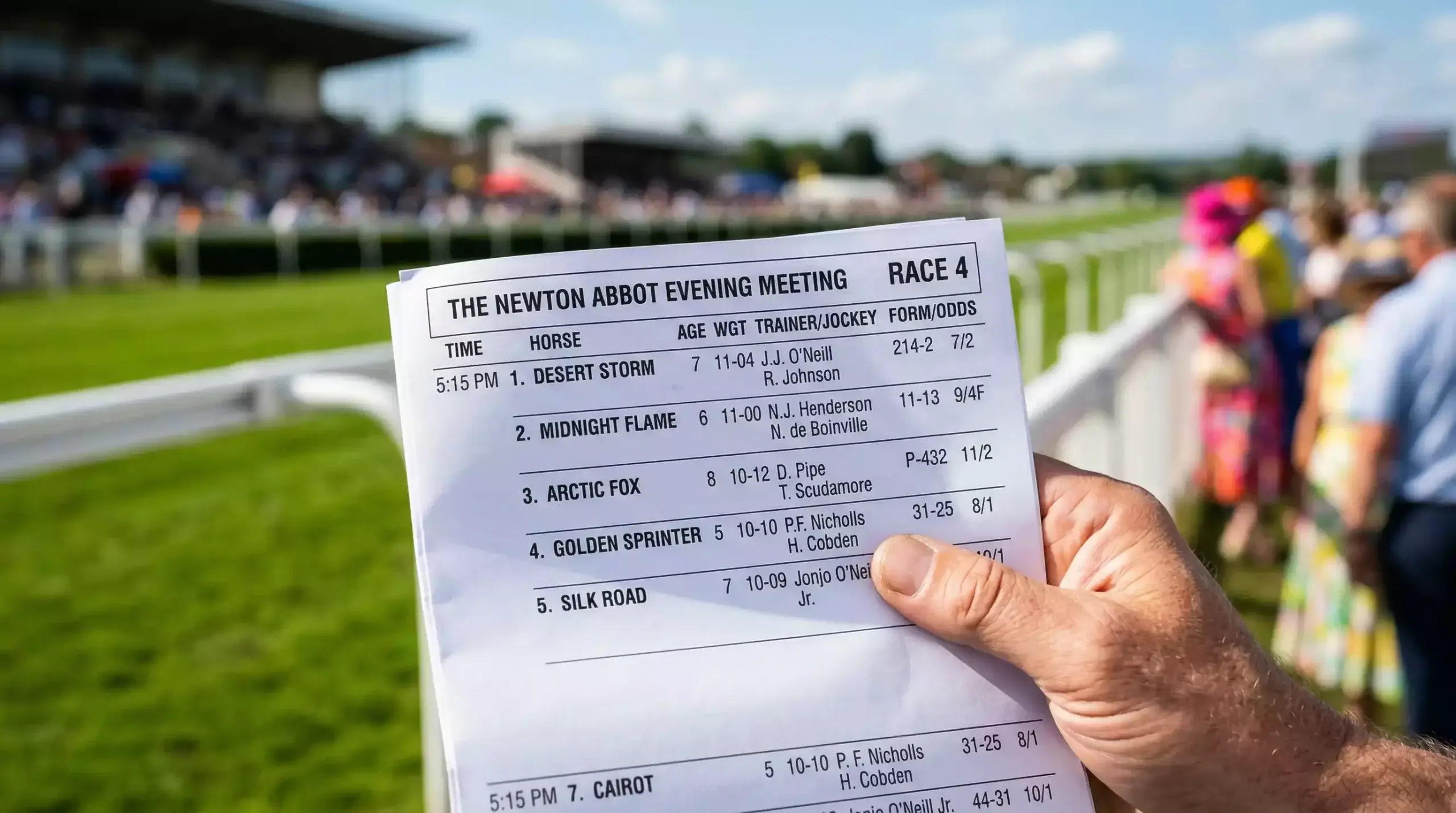

I placed my first horse racing bet on a cold November afternoon at Newbury, standing in a queue at the Tote window with a crumpled fiver and absolutely no idea what I was doing. The horse finished last. I had picked it because I liked the name. That was nine years ago, and the memory still makes me wince — not because I lost five pounds, but because I walked past a racecard stand, a form guide, and a perfectly legible information board without stopping to read any of them. Everything I needed was right there, and I ignored it.
Horse racing betting in the UK is one of the oldest forms of legal wagering in the world, and it remains one of the most accessible. Around 7% of British adults place a bet on the horses during peak season months like April and May, and that figure drops to roughly 4% in the quieter autumn period. The sport is not some niche hobby — it is a nationwide activity with deep cultural roots, and 68% of people who walk through a racecourse turnstile in any given year are casual visitors or first-timers. You do not need a background in data analysis or a lifetime of Saturday afternoons at Cheltenham to get started.
What you do need is a clear understanding of the process. Betting on horse racing involves more steps than tapping a football accumulator into an app, but each step has a logic to it, and once you see that logic, the whole thing clicks. This guide walks you through every stage — from opening a betting account and passing verification, through decoding a racecard and choosing which race to bet on, right down to clicking “confirm” on your betslip and understanding what happens after the horses cross the line.
Opening a Betting Account: What to Expect
The first time I helped a friend set up a betting account, he assumed it would take thirty seconds — download the app, enter an email, start betting. He was half right. The download takes thirty seconds. The rest takes a bit longer, and for good reason.
Every bookmaker licensed by the UK Gambling Commission must verify your identity before allowing you to place a bet or withdraw funds. This is not optional, and it is not something the bookmaker invented to annoy you. It is a legal requirement under anti-money-laundering regulations, and it applies to every operator holding a UKGC licence. The process is called Know Your Customer, or KYC, and it exists to confirm that you are who you say you are, that you are at least 18 years old, and that you are located in a jurisdiction where the bookmaker is permitted to operate.
To open an account, you will need a valid email address, a UK address, and a form of photo identification — usually a passport or driving licence. Most bookmakers also ask for proof of address, which can be a utility bill or bank statement dated within the last three months. Some operators run electronic verification checks that pull data from public records and credit reference agencies, which means you might be verified in minutes without uploading anything at all. Others require manual document submission, and that can take anywhere from a few hours to a couple of working days.
There is one more thing to be aware of. The Gambling Commission lowered the threshold for financial risk checks in February 2025, bringing the trigger point down to just 150 pounds in net deposits per month. If your spending crosses that line, the bookmaker may ask you to provide additional financial information. This is not a reflection on you personally — it is a blanket regulatory requirement that applies to everyone. I will be blunt: it is a pain, and it has driven a lot of experienced punters up the wall. But it is the landscape we operate in, and knowing about it before you sign up means you will not be caught off guard.
Once your account is verified, you can deposit funds. The usual methods are debit card, bank transfer, and e-wallets like PayPal or Skrill. Credit card deposits have been banned in the UK since April 2020, so do not bother looking for that option. Minimum deposits typically sit at five or ten pounds, depending on the bookmaker and the payment method.
The KYC Process and Verification Timeline
The verification timeline varies more than most people expect. I have had accounts verified electronically within two minutes and others that sat in a queue for 48 hours because the document upload system flagged a shadow on my passport photo. Electronic checks, where the bookmaker cross-references your details against databases, are usually instant if you enter your name, date of birth, and address exactly as they appear on official records. Problems arise when there is a discrepancy — a middle name missing, an old address still on file, or a recently issued document that has not yet reached credit reference agencies.
Manual document uploads add time. Most large bookmakers promise verification within 24 hours. My advice is to submit documents the day you create the account, even if the bookmaker has not asked for them yet. One thing worth knowing: some bookmakers let you deposit and bet before verification is complete, but they will not process a withdrawal until KYC is cleared. Others lock the account entirely until the check is done. Read the terms before depositing.
Reading a Racecard: Every Field Decoded
A racecard looked like hieroglyphics to me for the first six months. Numbers crammed next to abbreviations, tiny superscript figures, colour codes that meant nothing — I used to skip it entirely and just pick the horse with the shortest odds. That worked about as well as you would imagine.
The racecard is the single most important piece of information available to you before a race. It tells you everything the bookmaker already knows, and it is free. Every racing newspaper, website, and app publishes racecards for every meeting, and once you learn how to read one, you will never place a blind bet again.
Here is what a typical UK racecard contains. The horse’s name sits at the centre, usually in bold, alongside its saddlecloth number. The draw number, shown in brackets for flat races, tells you which starting stall the horse has been assigned — on certain courses like Chester, the draw has a significant impact on sprint results. The trainer and jockey are listed alongside the horse’s name. A trainer’s strike rate at a particular course, or a jockey’s record in a specific race type, can be a genuine edge.
You will also see the horse’s age and weight. In handicap races, the weight is assigned by the official handicapper based on the horse’s rating and directly affects the horse’s chances. The form figures — a string of numbers and letters next to the horse’s name, reading right to left with the most recent run on the far right — are a compressed history of recent performances. A “1” means the horse won, “2” means second, “0” means outside the top nine. A dash separates seasons. Letters like “F” (fell), “U” (unseated rider), “P” (pulled up) and “R” (refused) indicate incomplete races.
Other fields include the official rating (OR), a numerical assessment of ability from the BHA handicapper; headgear codes like “b” for blinkers, “v” for visor, or “t” for tongue tie; and the going preference, showing what ground conditions the horse has historically preferred.
What the Form Figures Actually Tell You
The numbers in a form string are only half the story. A horse that finished third last time out might have been beaten by a neck in a Group 1 race at Ascot, which is a very different performance from finishing third in a six-runner novice event at Plumpton. Context is everything.
When I assess form, I look at three things before anything else. First, the level of competition — was the horse racing in a handicap, a conditions race, a listed event, or a group race? Each step up the ladder represents a significant increase in quality. Second, the margin of victory or defeat. A horse beaten half a length by a subsequent winner is in much better form than one beaten twelve lengths by a horse that has not won since. Third, the going. A horse that ran a lifeless race on heavy ground might transform on a faster surface, and the form figures alone will not tell you that.
Letters in the form string deserve particular attention in National Hunt racing. An “F” does not just mean the horse fell — it means the horse was travelling well enough to be in contention when it made a mistake at a fence, and it tells you something about the horse’s jumping ability (or lack of it). A “P” can mean many things: the horse might have been pulled up because it was clearly beaten, or because it was injured, or because the jockey felt something was wrong. Checking the race replay, where available, adds a layer of information that the form string cannot capture.
One pattern I have found useful over the years is looking at the form of horses dropping in class. A horse with a string of mid-division finishes in Class 2 handicaps that drops into a Class 4 event is often underestimated by the market. The form figures look mediocre at a glance — fives, sixes, sevens — but relative to the level it is now competing at, those runs might indicate a horse with more ability than its rivals. The reverse applies too: a horse stepping up sharply in class after a win at a lower level is a risk the market sometimes underprices.
Picking a Race: Fixture Types and What They Signal
Not all race meetings are created equal, and understanding the difference between fixture types will save you from betting into races where the information advantage is stacked against you.
British racing operates a tiered fixture system. At the top sit Premier fixtures — the big meetings at Ascot, Cheltenham, York, Newmarket, and a handful of other elite venues. These attract the best horses, the best jockeys, and the most media coverage. The form book for these races is deep and well-documented, which means the market is efficient and finding value is harder. Below that are standard fixtures, which make up the majority of the racing calendar. These are the bread-and-butter meetings at courses across the country, and they offer a wider spread of competitive quality. Further down are what the BHA classifies as Core fixtures, which tend to feature lower-grade racing with smaller fields.
For a beginner, standard fixtures are the best place to start. The races are competitive enough to be interesting, the form is reasonably accessible, and the fields are large enough to create genuine each-way opportunities. Premier fixtures are exciting to watch but brutal to bet on, because the market is flooded with information and professional money. Core fixtures can feel unpredictable, with lower-quality horses producing inconsistent results.
Race timing matters too. In Q1 2025, 87.6% of British races started within two minutes of their scheduled time, up from 79.2% in 2024. That improvement is relevant because it means you can trust the programme times and plan your betting accordingly. If you are working through the card at a multi-race meeting, knowing that the 3:15 will go off within a couple of minutes of 3:15 allows you to study the next race during the current one, rather than scrambling to make last-second decisions.
I would also suggest paying attention to the number of runners declared. Small fields — five or six runners — produce fewer upsets, which is reassuring for a beginner but also means the odds are shorter and the potential payouts are smaller. Large fields of fifteen or more runners are less predictable, but the each-way terms become more generous and the prices are longer. Finding a balance between field size and your own risk tolerance is part of the learning process.
Placing Your Bet: From Selection to Confirmation
I remember the first time I placed a bet online and spent a full minute staring at the betslip, convinced I was about to accidentally stake 200 pounds instead of 2. The interface was clear enough — I just did not trust myself yet. That feeling fades quickly once you understand the anatomy of a betslip.
The process starts with selecting your horse. On most bookmaker websites and apps, you click or tap the odds next to a horse’s name on the racecard page, and the selection is added to your betslip. The betslip then shows you the horse’s name, the race it is running in, the current odds, and a box where you enter your stake. Below the stake box, you will see the potential return — the amount you would receive if the bet wins, including your original stake.
Before you confirm, check three things. First, verify that the odds have not changed since you added the selection. Prices can move rapidly in the minutes before a race, and some bookmakers default to accepting the new price rather than alerting you to the change. Second, confirm the bet type. A win bet and an each-way bet are not the same thing, and placing an each-way bet costs double the stated stake because it is two separate bets — one on the win and one on the place. Third, check the amount. It sounds obvious, but a misplaced decimal point is the kind of mistake you only make once.
Once everything looks right, hit the confirm button. The bookmaker returns a confirmation screen with the bet reference number, selection, odds, stake, and potential return. Most bookmakers also store your bet history in a “my bets” section, making it easy to track live wagers.
One thing that catches some people out is the difference between taking a price and accepting SP (starting price). When you place a bet at the odds displayed on screen, you are locking in that price. If the horse drifts to longer odds before the off, you keep the shorter price. If it shortens, you still get the price you took. SP, on the other hand, means your bet is settled at whatever the official starting price turns out to be when the race begins. I almost always take the price I see, unless I have a strong reason to think the horse will drift — and even then, I would rather lock in a known number than gamble on the market moving in my favour.
Mobile Betting: How Most Punters Wager Today
More than 80% of bets placed on the Cheltenham Festival in 2024 came through mobile devices. That number surprised me when I first saw it, but it should not have — I do the same thing myself. The phone is where most of us check form, watch live streams, and place bets, often simultaneously.
Every major UK bookmaker offers a dedicated mobile app for iOS and Android, and the experience has improved enormously over the past few years. Live streaming of UK and Irish racing is available directly within most apps, which means you can watch the race you have bet on without switching to a separate screen. In-play betting — placing bets while a race is running — is also accessible through the app, though I would advise beginners to stay away from it until they are comfortable with pre-race betting.
The mobile experience does have a couple of drawbacks worth mentioning. Screen size makes it harder to compare multiple horses at once, which is something you can do much more easily on a desktop or with a printed racecard. Push notifications from bookmakers can also be relentless, nudging you towards bets you have not researched. I turned off promotional notifications on every app within a week of installing them, and I would recommend doing the same. The useful notifications — bet settled, race result, price change on a tracked horse — can stay on.
If you are betting at the racecourse itself, mobile connectivity can be patchy. Placing your bets before you arrive, or while you still have a strong signal, avoids the frustration of watching a loading spinner as the race is about to start.
How Bets Are Settled: Results, Dead Heats, Non-Runners
A surprising number of new bettors place a bet, watch the race, and then are not entirely sure whether they have won or lost. It sounds ridiculous, but it happens — especially in each-way bets, dead heats, and races affected by non-runners.
The simplest scenario is a win bet on a horse that wins. The bookmaker settles at the agreed odds, and your return appears in your account within minutes of the result being confirmed. In close finishes, a photo may be called, which delays the result briefly while stewards examine the image. Dead heats occur when two horses cannot be separated — your win bet is then settled at half the odds. A horse backed at 10/1 for ten pounds that dead-heats would return 60 pounds instead of the full 110.
Non-runners trigger a different set of rules. If your horse is declared a non-runner before the off, your stake is returned in full. However, a Rule 4 deduction may apply to winning bets on the remaining runners if the withdrawal shortened the odds on other horses. The deduction scale runs from 5p in the pound for a long-priced non-runner to 90p in the pound for an odds-on favourite.
Stewards’ enquiries can also affect the result after the race. If interference is confirmed, stewards can demote or disqualify a horse — and if a horse you backed is demoted from first, your win bet loses. This is rare at the top level but happens enough in lower-grade National Hunt racing to be worth knowing about.
Cash Out and In-Play Betting on Races
Cash out is one of those features that sounds brilliant in theory and can be terrible in practice if you do not understand what is actually happening behind the button.
The concept is straightforward. If you have an open bet and the race is approaching or already underway, the bookmaker offers you a price to close the bet early. If your horse is going well, the cash-out value will be higher than your original stake — a guaranteed profit in exchange for giving up the full payout. If your horse is struggling, the cash-out value drops below your stake, offering a partial recovery instead of a total loss.
The catch is that the cash-out price is set by the bookmaker, not by you. The bookmaker builds a margin into every cash-out offer, just as they build a margin into the original odds. You will never be offered a mathematically fair value. Over time, consistently cashing out eats into your returns in the same way the overround does on every bet you place.
In-play betting on horse racing works differently from football or tennis. Races are short — a flat sprint can be over in under a minute, and even a three-mile steeplechase takes only six or seven minutes. The odds change rapidly, and the latency between what you see on a live stream and what the bookmaker’s algorithm has priced in means you may be betting on stale information. For beginners, I would leave in-play alone entirely until you have a solid grasp of pre-race betting.
Five Beginner Mistakes and How to Sidestep Them
I have made every one of these mistakes myself, some of them more than once. The good news is that they are all avoidable once you know what to watch for.
The first mistake is chasing losses. You back a horse, it loses, and you immediately place another bet to “win it back.” This is the fastest way to burn through a bankroll. The second bet is almost always less researched than the first, placed in frustration rather than conviction, and at odds that do not reflect genuine value. I spent an entire Cheltenham Tuesday in my second year doing exactly this, turning a 20-pound loss into a 90-pound loss by the last race. The correct response to a losing bet is to do nothing. The next race does not know or care that you lost the previous one.
The second mistake is ignoring the going. Ground conditions affect race outcomes more than almost any other variable, and beginners routinely overlook them. A horse with brilliant form on good-to-firm ground can be a completely different animal on heavy ground, and vice versa. Checking the going report — published by the racecourse on the morning of the meeting and updated if conditions change — takes 30 seconds and can prevent you from backing a horse that is fundamentally unsuited to the surface.
Third: betting on every race. A typical afternoon card has six or seven races. You do not need to bet on all of them. Professional punters might only find value in one or two races across an entire day, and they are happy to sit out the rest. Beginners feel like they are “wasting” a race meeting if they do not have a bet in every race, but the opposite is true — the discipline to skip a race where you have no opinion is one of the strongest signals that you are approaching this seriously.
Fourth is misunderstanding each-way terms. New bettors often place an each-way bet thinking they are risking the stated stake, when in fact they are risking double. A ten-pound each-way bet costs 20 pounds, because it is a ten-pound win bet and a ten-pound place bet. The place terms — how many positions pay out and at what fraction of the odds — vary depending on the number of runners and the type of race. Not checking these terms before placing the bet is a common and expensive error.
The fifth mistake ties into a broader problem across the sport right now. Betting turnover on British racing dropped 9% in Q1 2025 compared to the same period the year before, and BHA Director of Racing Richard Wayman pointed to a range of factors behind what he called a “concerning decline.” One of those factors is the changing relationship between bettors and operators, driven partly by affordability checks and partly by shifting habits. New bettors sometimes feel that the industry is unwelcoming or overly complicated, and that perception leads them to either stop betting or move to less regulated alternatives. The mistake, from a bettor’s perspective, is giving up before learning the system. The process is more involved than it used to be, but the racing itself has never been more accessible, and the information available to you as a bettor is better than it has ever been.
Common Questions About Placing Horse Racing Bets
If you have read this far, you already know more about the mechanics of horse racing betting than the vast majority of people who place their first wager. The process has more moving parts than a football coupon, but each part serves a purpose, and none of them are as complicated as they look from the outside. Start with one race, one bet type, and one bookmaker. Build from there. And if you want to understand the numbers behind the odds you are seeing on screen, the next step is learning how horse racing odds actually work — the maths is simpler than you expect.
