
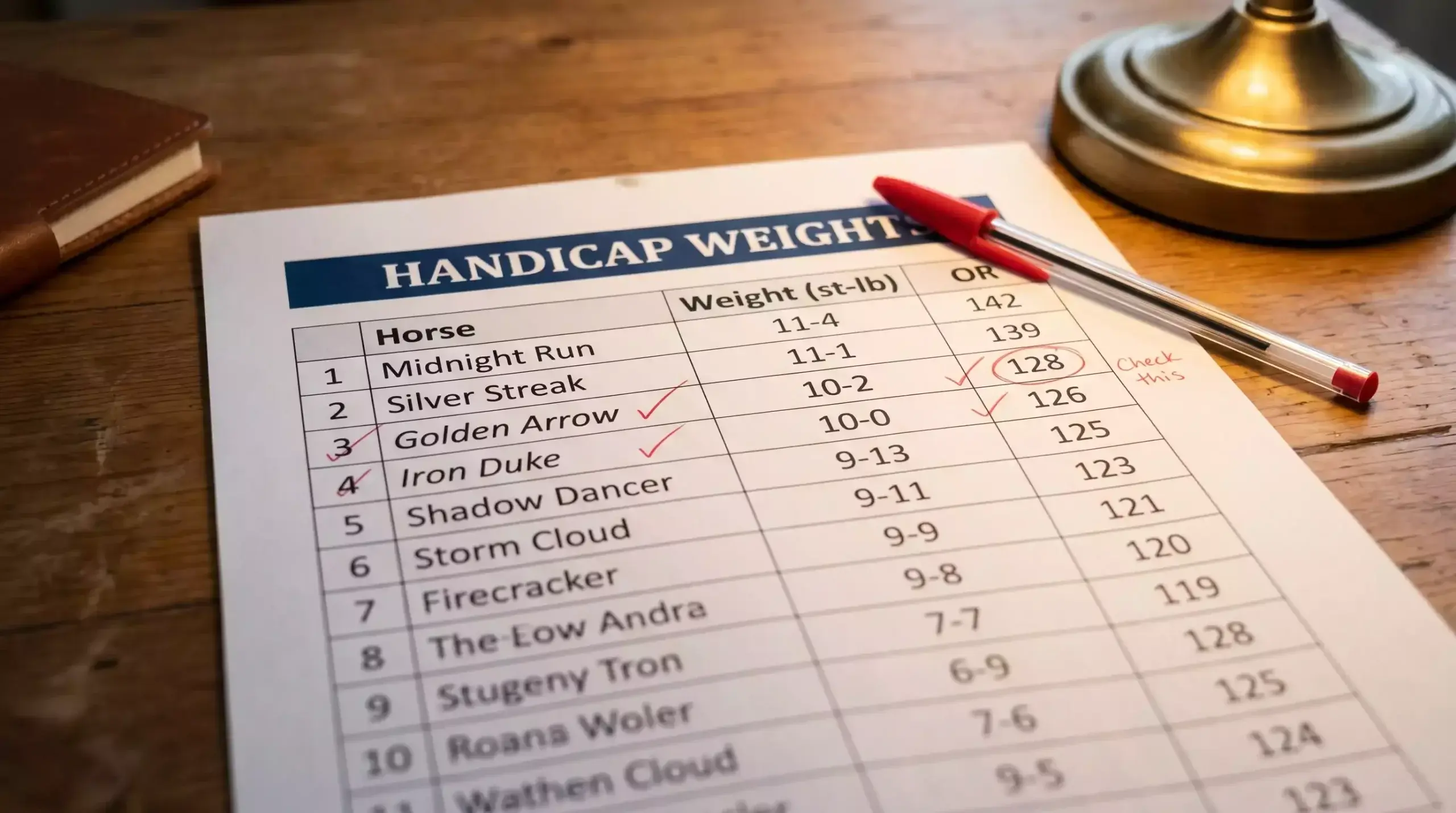

Handicaps are where I make the bulk of my profit. Not because handicaps are easy — they are chaotic, competitive, and full of horses separated by a pound or two on the handicapper’s scale. But that chaos is precisely what creates value. When fifteen horses are theoretically equalised by weight, the form study that identifies the one whose ability has outstripped its rating is what turns a Saturday handicap into a profitable bet. British racing’s total prize fund hit 194.7 million pounds in 2025, and a substantial share of that money is funnelled into handicap races — the lifeblood of the fixture list from Class 2 at York down to Class 6 at Wolverhampton.
This article explains how the handicapping system works, how to spot horses the handicapper has underrated, and why big-field handicaps are fertile ground for each-way punters.
How the BHA Handicapper Assigns Ratings and Weights
The BHA employs a team of handicappers whose job is to assess every horse’s ability and express it as a single number — the official rating (OR). A flat horse rated 90 is deemed better than one rated 75 but weaker than one rated 105. In a handicap race, the horse with the highest rating carries the most weight, and every horse below it carries proportionally less — typically one pound less for each rating point.
Ratings are updated after every run. If a horse wins impressively, the handicapper raises its rating — usually by 3-7 pounds depending on the winning margin, the quality of the field, and the race context. If a horse runs below expectations, the rating might be lowered. There were 15,070 horses in training in Britain in early 2025, and each of those with a handicap mark carries a rating that the handicapper adjusts based on performance.
The handicapper is trying to create a race where every runner has an equal chance. In theory, the top-rated horse carries enough extra weight to neutralise its superior ability, and the bottom-rated horse carries light enough to compensate for its lesser talent. In practice, handicapping is an imperfect art. Horses improve (or decline) between races, and the rating at the time of entry does not always reflect current ability. That gap between assigned rating and true ability is where the betting edge lives.
One structural detail matters: the rating used for a handicap is locked in at the time of declaration, not the time of the race. A horse might win on Saturday, get its rating raised on Tuesday, but still run off the lower mark in a race the following Thursday if it was declared before the reassessment. This timing mechanism creates windows where a recently improved horse runs off a lower rating than its current form deserves — precisely the kind of well-handicapped runner that punters seek.
Spotting a Well-Handicapped Horse
A well-handicapped horse is one whose current ability exceeds its official rating. The handicapper has not yet caught up with the horse’s improvement, either because the improvement happened between races (better fitness, a training breakthrough) or because the horse’s recent run was not given full credit by the assessor.
The classic pattern is a horse returning from a break. After three or four months off, a horse might be significantly fitter or better trained than when it last ran. The handicap rating reflects old form. If the stable signals confidence — a jockey booking upgrade, a drop in trip to a preferred distance, first-time headgear — the combination of stale rating and improved horse is a recipe for outperformance.
Another pattern: horses dropping in class. A horse rated 95 competing in Class 2 handicaps faces stiff opposition. Drop it into a Class 3 or Class 4, and the same rating puts it near the top of the weights but against weaker opponents. The weight it carries is technically fair, but the quality of the competition is lower, which improves its relative chance. Class drops are visible on the racecard and are one of the simplest well-handicapped indicators to spot.
The reverse — a poorly handicapped horse — is equally useful. A horse whose rating has been raised after a flattering win (perhaps it was suited by a pace collapse or a weak field) may be overrated for its next start. Opposing that horse, or at least avoiding it, is a disciplined way to filter a handicap field.
One warning: the market prices in well-handicapped status quickly. If a horse is obviously well treated, the odds will reflect it. The most profitable well-handicapped runners are those whose improvement is not yet public knowledge — horses returning from a break where stable information is private, or horses whose rating drop has been quiet and gradual rather than dramatic.
Big-Field Handicaps: Each-Way and Place Angles
BHA research through Project Beacon identified over 25 million potential new fans for the sport — and many of those future fans will encounter horse racing for the first time through big-field handicaps on televised Saturday cards. These races, with fields of 16 to 30+ runners, are the heartbeat of the betting product.
Each-way betting comes into its own in big-field handicaps. With 16+ runners, the standard place terms cover the first three or four places at one-quarter the odds. Many bookmakers extend place terms for the biggest races — five, six, or even eight places in a 20+ runner field. Those extra places significantly increase the probability of collecting on the place part of an each-way bet.
The value in big-field handicap each-way betting lies in backing horses whose true probability of placing exceeds what the odds imply. In a 20-runner handicap where the weights are designed to equalise the field, each horse has roughly a 5% chance of winning in theory. A horse at 20/1 is priced at an implied 4.8% win probability — close to the equalised baseline. But if that horse has strong course form, a going preference that matches today, and a jockey booking that signals stable intent, its true place probability might be significantly better than 20% (the implied probability of placing in the top four at 20/1 each-way with quarter-odds terms).
The mathematics of big-field each-way is driven by the place fraction. At quarter-odds, the place part of a 20/1 each-way bet pays at 5/1. The implied place probability at 5/1 is about 17%. If you assess the horse’s true place probability at 25-30% — considering the attrition from non-completions in jumps handicaps, the going, the draw, and form — the each-way bet carries positive expected value on the place part alone, regardless of whether the horse wins.
I approach big-field handicaps with a simple rule: identify three or four horses with strong placing credentials and back them each-way at the longest available price. I do not try to find the winner. I try to find horses that will finish in the top four or five, and let the place returns accumulate over time.
